
Why Diesel Fuel Delivery Is a Game Changer for Your Business
Diesel fuel delivery is a service where a supplier brings fuel directly to your job site, fleet yard, or equipment — so your operation never stops because of an empty tank.
Here’s what you need to know at a glance:
| What It Is | Who It’s For | Key Benefit |
|---|---|---|
| On-site fuel delivery to tanks, equipment, or fleets | Construction, farming, trucking, logistics | No downtime from empty tanks |
| On-road (clear) diesel for highway vehicles | Fleet managers, trucking companies | Tax-compliant fuel, delivered direct |
| Off-road (red-dyed) diesel for equipment | Farms, job sites, generators | Tax-exempt savings, no station trips |
| Emergency and scheduled delivery options | Any fuel-dependent operation | 24/7 availability when you need it most |
Every hour your equipment sits idle because of a fuel shortage is money out of your pocket. For fleet managers and business owners in construction, agriculture, and logistics, that’s not a minor inconvenience — it’s a real threat to your bottom line.
The good news? Diesel fuel delivery solves this problem completely. Instead of sending drivers to the pump or scrambling during a shortage, fuel comes to you — on your schedule, at your site, in the exact volume you need.
I’m Kyle Behnke, a business professional based in Atlanta and part of the FuelSource team, where I work closely with fleet operators and businesses that depend on reliable diesel fuel delivery to keep their operations moving. My background in business strategy and operations gives me a practical, ground-level view of what actually works in this industry.
Understanding the Core Benefits of Diesel Fuel Delivery
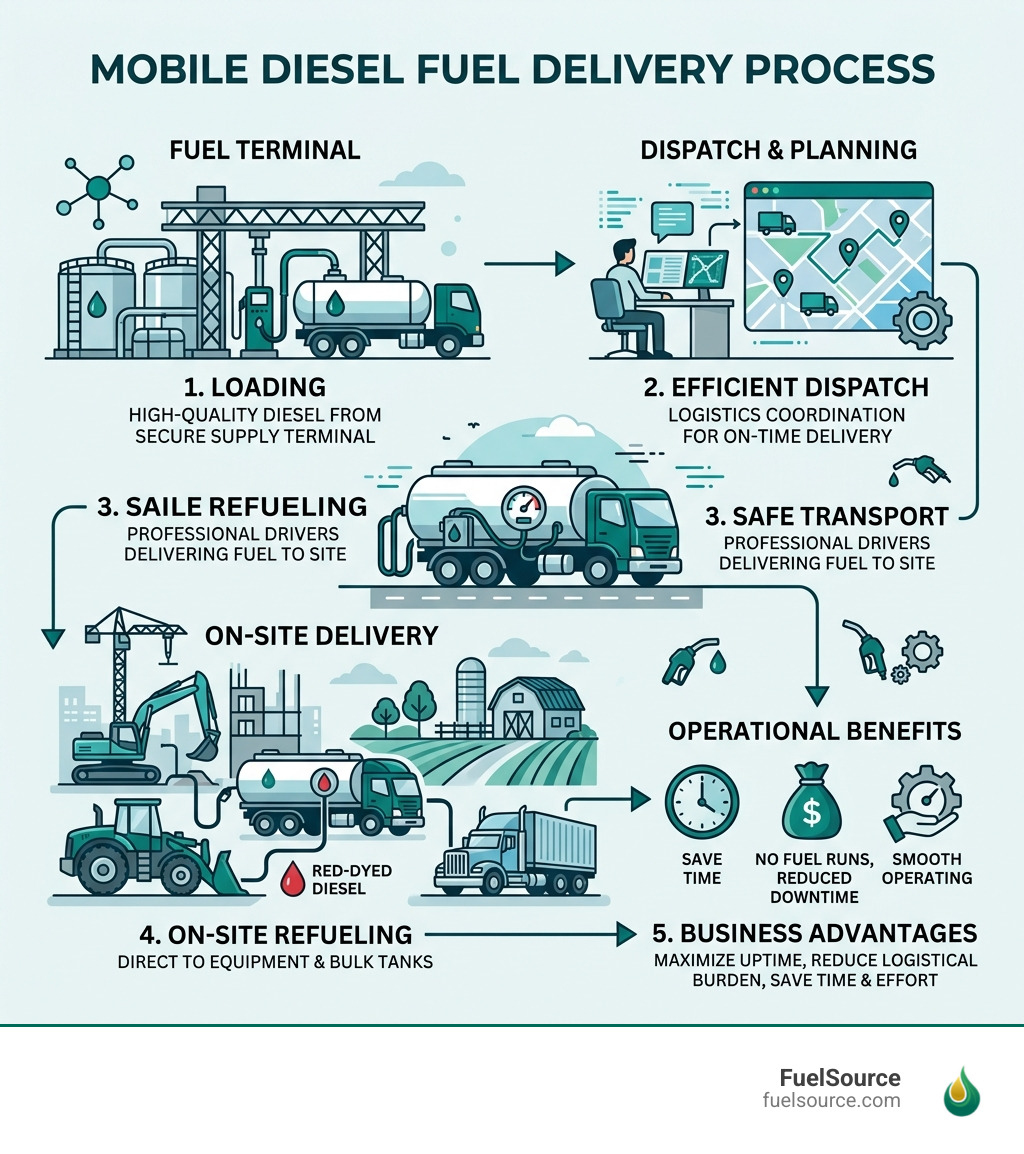
At its heart, diesel fuel delivery is about reclaiming your most valuable asset: time. When we talk about mobile refueling, we aren’t just talking about a truck showing up with a hose. We’re talking about a sophisticated logistics solution designed to keep heavy machinery, transport fleets, and backup generators running without the logistical nightmare of “station runs.”
In the Atlanta Metro and North Georgia regions, where traffic can turn a quick trip to the fuel station into a two-hour ordeal, having fuel brought directly to your yard is a massive competitive advantage. Whether you are running a construction site in Marietta or a farm in Bartow County, the ability to have high-quality Ultra-Low Sulfur Diesel (ULSD) pumped directly into your tanks changes the math of your daily operations.
Beyond just convenience, On-Site Fueling ensures that you are using the right fuel for the right job. This includes regulatory compliance—ensuring your off-road equipment is using dyed diesel to capture tax savings, while your highway trucks stay legal with clear diesel.
On-Road vs. Off-Road Diesel Requirements
One of the first things we help our customers understand is the difference between clear and dyed diesel. It’s not just about the color; it’s about your bottom line and staying on the right side of the law.
- On-Road Diesel (Clear): This is the standard Ultra-Low Sulfur Diesel you see at gas stations. It is “clear” (actually a light straw color) and includes all federal and state motor fuel taxes. It’s required for any vehicle that travels on public highways, like your semi-trucks, delivery vans, and service pickups.
- Off-Road Diesel (Red-Dyed): This fuel is chemically identical to on-road diesel but contains a red dye. This dye tells inspectors that the fuel is for “non-highway” use. Because this fuel isn’t used on public roads, it is exempt from certain motor fuel taxes.
Using red-dyed diesel for your excavators, generators, and farm tractors in places like Cherokee or Forsyth County can save you significant money per gallon. However, putting dyed diesel in a highway vehicle can lead to massive fines. A reliable diesel fuel delivery partner ensures these two products never get mixed up.
Maximizing Efficiency with On-Site Diesel Fuel Delivery
The “old way” of fueling involves drivers starting their day by heading to a retail station, waiting in line, swiping a card, and maybe grabbing a snack. That’s 30 to 45 minutes of paid labor spent not working.
We prefer the “new way”: Wet hosing.
Wet hosing, or direct-to-equipment fueling, means our trucks arrive at your site during your fleet’s idle time (usually at night or early morning). We pull up to every individual truck or piece of machinery and fill the tanks right where they sit. When your crew arrives at 6:00 AM, every machine is topped off and ready to roar. This level of fleet fuel delivery maximizes asset utilization and eliminates the “dead time” associated with traditional refueling.
As we’ve noted before, why Atlanta’s fuel delivery for fleets is the lifeblood of Georgia business comes down to this: if your wheels aren’t turning, you aren’t earning.
The Strategic Advantages of Diesel Fuel Delivery
Why choose mobile delivery over a standard fuel card? Let’s look at the numbers. While retail prices might occasionally look lower on a marquee, the “true cost” of retail fueling is almost always higher.
| Factor | Retail Station Fueling | Mobile Diesel Fuel Delivery |
|---|---|---|
| Labor Cost | Driver paid to wait in line/traffic | Zero (fueling happens during idle time) |
| Wear & Tear | Miles driven to/from station | Zero (equipment stays on-site) |
| Fuel Theft | High risk (untracked “extra” gallons) | Low (metered delivery to specific units) |
| Compliance | Manual receipt tracking | Digital reporting & IFTA support |
| Productivity | 1-2 hours lost per day | 100% uptime |
By utilizing diesel fuel delivery, you gain access to bulk pricing that is often much more competitive than the “street price” at a local pump. Furthermore, you gain supply chain reliability. When local stations run dry during a storm or a supply crunch, a dedicated delivery partner with terminal access ensures your business keeps moving.
Customizing Your Diesel Fuel Delivery Schedule
Every business has a different rhythm. A landscaping crew in Gwinnett County might only need a refill twice a week, while a massive data center in Douglas County needs their backup generators topped off immediately after a power outage.
We offer several ways to manage your supply:
- Automatic Delivery: We use tank monitoring technology to track your levels. When you hit a certain percentage, we automatically dispatch a truck. You never have to pick up the phone.
- Scheduled Refills: A set-it-and-forget-it option where we show up on specific days (e.g., every Monday and Thursday morning).
- Will-Call: You monitor your own tanks and call us when you’re ready for a drop.
- Emergency Services: Because things happen. Whether it’s an unexpected surge in work or a natural disaster, 24/7 availability is a must-have for any serious operation.
Fuel Delivery for Fleets Across Diverse Industries
Diesel is the fuel that builds and moves Georgia. We see the impact of reliable delivery across dozens of sectors:
- Construction: Keeping yellow iron moving on job sites without having to haul equipment to a central tank.
- Agriculture: Delivering dyed diesel directly to tractors and harvesters in the field during the busy season.
- Municipalities: Ensuring waste management trucks and emergency vehicles are always ready for the community.
- Logistics & Food Distribution: Fueling refrigerated “reefer” units and long-haul trucks during their mandatory rest periods.
Advanced Fuel Management and Storage Solutions

One of the biggest headaches for fleet managers is paperwork. If you are still chasing paper receipts from drivers, you are losing money to human error. Modern diesel fuel delivery is as much about data as it is about fuel.
By using Tank Goodness, you can implement smart storage solutions. We provide double-walled tanks that meet all environmental safety standards, equipped with electronic monitoring. This data flows directly into a cloud-based tracking system, giving you a bird’s-eye view of your inventory across multiple sites—from Paulding County to DeKalb County.
This digital verification is a lifesaver for International Fuel Tax Agreement (IFTA) reporting. Instead of guessing how much fuel was used in-state versus out-of-state, or for on-road versus off-road use, you have a timestamped, metered record for every single gallon.
Integrated Products: DEF, Lubricants, and Additives
A modern diesel engine needs more than just fuel to stay healthy. Since 2010, most diesel engines require Diesel Exhaust Fluid (DEF) to meet emissions standards. If your DEF tank runs dry, your engine will go into “limp mode,” effectively shutting down your operation.
We provide integrated DEF Fluid Delivery alongside our diesel services. We can fill your DEF tanks at the same time we fill your fuel, ensuring you stay compliant with ISO 22241 standards.
Additionally, we offer:
- Winter Blends: To prevent fuel “gelling” during those surprisingly cold North Georgia winters.
- Fuel Stabilizers: To keep fuel fresh in standby generators that might sit for months.
- Lubricants & Specialty Chemicals: High-quality engine oils and hydraulic fluids to keep your machinery in peak condition.
Choosing a Reliable Fuel Delivery Partner
Not all fuel providers are created equal. When you are looking for a partner in the Georgia market, you need to look beyond the price per gallon.
First, consider regional coverage. Do they actually have trucks near Marietta, Canton, and Decatur? A provider with a broad footprint in the Atlanta Metro area can respond faster when you have an emergency.
Second, look at technology. Do they offer a customer portal? Can you get instant reports? In 2026, you shouldn’t have to wait for a mailed invoice to know how much fuel you used yesterday.
Finally, check their supply chain ownership. A reliable partner has strong relationships with multiple terminals. This ensures that even if one terminal has a disruption, they can pull fuel from another source to keep your tanks full.
Frequently Asked Questions about Diesel Fuel Delivery
What are the typical minimum volume requirements for delivery?
This varies depending on the provider, but many modern services are becoming more flexible. While some “big oil” companies might require 500 or 1,000 gallons per drop, we understand that smaller operations in places like Rockdale or Walton County might have smaller needs.
We utilize “bobtail” trucks which are smaller and more maneuverable than massive transport tankers. This allows us to handle everything from a small 50-gallon generator fill-up to a 10,000-gallon bulk tank replenishment. Custom pricing is usually available based on your specific volume and frequency.
How do factors like market volatility affect diesel pricing?
Diesel prices are influenced by global crude oil markets, refinery production, and local demand. Most businesses choose between two pricing models:
- Daily Spot Pricing: You pay the current market rate on the day of delivery. This is great when prices are falling.
- Fixed Contracts: You lock in a price for a set period. This provides “budget certainty,” which is excellent for long-term construction bids where you need to know your exact costs.
We source directly from wholesale “rack” rates, allowing us to pass savings onto our customers that you simply won’t find at a retail station.
What is the process for setting up emergency or weekend fueling?
When disaster strikes—like a major storm hitting North Georgia—fuel becomes the most valuable commodity on the market. Setting up emergency service starts with a simple phone call or online request.
We maintain a 24/7 dispatch team specifically for rapid mobilization. Whether you need to keep hospital generators running or need to fuel a fleet of utility trucks working on power restoration, we can often be on-site within hours. For our regular customers, this “priority response” is a standard part of the partnership.
Conclusion
At the end of the day, diesel fuel delivery is about peace of mind. It’s about knowing that when your crew turns the key at the start of a shift, the engine will start. It’s about removing the “fuel run” from your daily to-do list so you can focus on growing your business.
With over 30 years of experience serving the Atlanta Metro and North Georgia areas, FuelSource has the state-of-the-art equipment and local expertise to handle your most challenging fueling needs. From our transparent customer portal to our real-time IFTA reporting, we provide the tools you need to manage your fuel as efficiently as you manage your people.
Ready to stop wasting time at the pump? Get Started with Reliable Diesel Delivery today and see the difference a professional fuel partner can make for your bottom line. Whether you’re in Fulton, Gwinnett, or Coweta County, we’ve got you covered.