
Why Mobile DEF Refueling Keeps Fleets Moving
Mobile DEF refueling brings ISO 22241-quality diesel exhaust fluid directly to your yard, job site, equipment, or on-site tank. For Atlanta-area fleets, the best service fits your DEF usage, offers scheduled or urgent delivery, and uses clean, dedicated dispensing equipment to protect SCR systems.
DEF is essential for modern diesel engines using selective catalytic reduction. Many fleets use roughly one gallon of DEF for every 50 gallons of diesel burned. If DEF runs low, equipment can derate, reducing power when you need it most.
For construction, farming, and logistics operations, on-site DEF supply helps avoid truck-stop jug costs, driver detours, and preventable downtime. It also makes it easier to keep generators, trucks, and Tier 4 Final equipment ready for work.
I’m Kyle Behnke, a business and operations professional in the Atlanta area with a background from Emory University’s Goizueta Business School. My focus on practical fleet operations helps shape this guide to Mobile DEF refueling and the decisions that reduce downtime. For broader context on how diesel exhaust fluid fits into emissions control, the selective catalytic reduction process is a useful reference.
Understanding Mobile DEF Refueling: Technology, Hardware, and Delivery Models
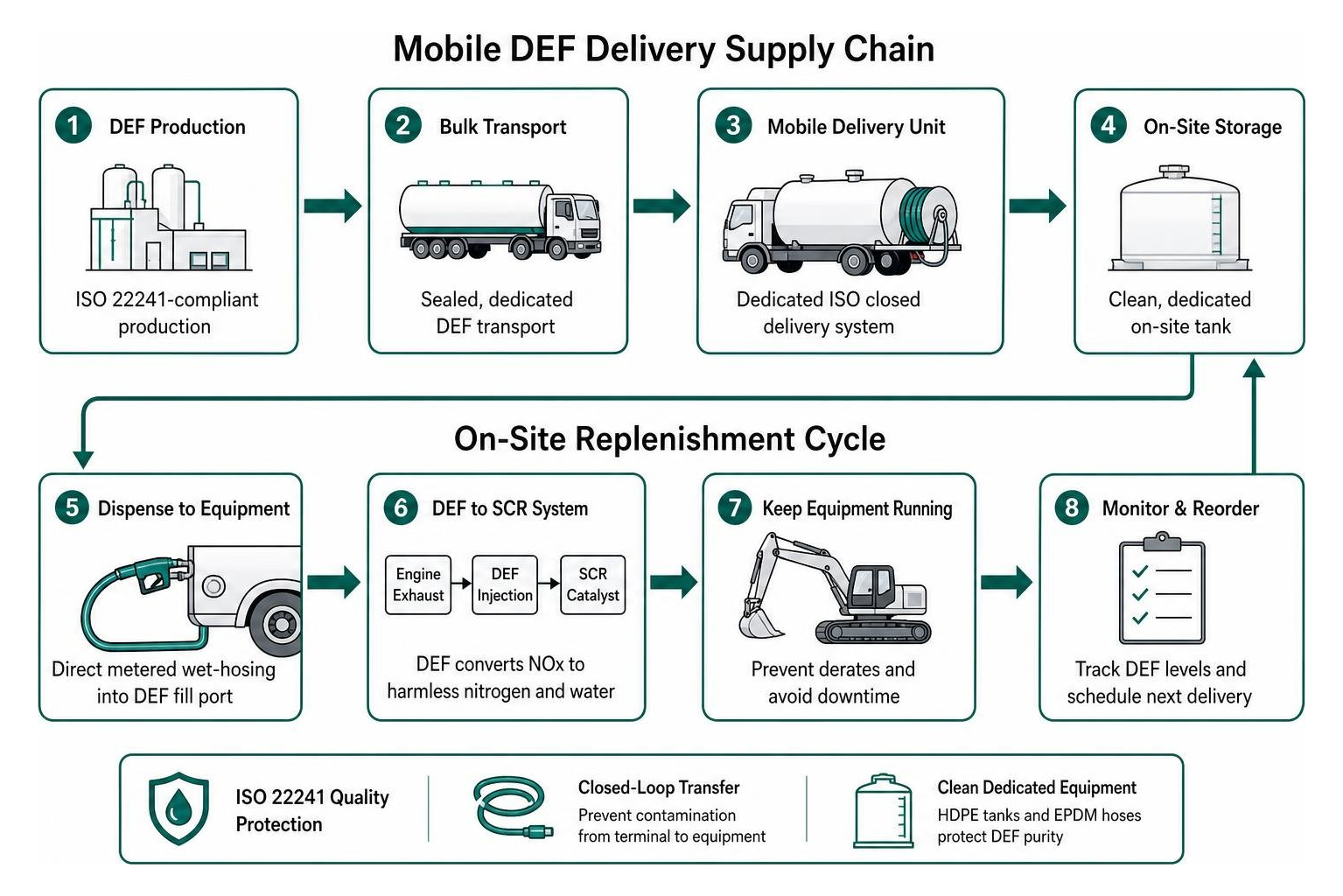
Diesel Exhaust Fluid (DEF) is a precisely balanced solution of 32.5% high-purity synthetic urea and 67.5% deionized water. It is not an additive mixed into fuel; rather, it is injected directly into the exhaust stream of modern diesel engines. Inside the Selective Catalytic Reduction (SCR) catalyst, DEF vaporizes into ammonia and carbon dioxide, reacting with harmful nitrogen oxides (NOx) to convert them into harmless nitrogen gas and water vapor.
Because every on-highway commercial diesel truck built since 2010 and every off-road machine manufactured to Tier 4 Final standards since 2014 relies on an SCR system, DEF is as critical to your daily operations as diesel fuel itself. Operating these engines on a standard 1:50 consumption ratio against diesel burn means that fluid replenishment cannot be treated as an afterthought.
Mobile DEF delivery eliminates the logistical friction of handling individual retail jugs by bringing bulk, commercial-grade fluid directly to your machinery. Purity is the primary engineering priority. Even microscopic traces of minerals, oil, or tap water can poison the catalyst in an SCR system, triggering severe engine power derates and expensive shop repairs.
To maintain ISO 22241 compliance from the terminal to your vehicle’s fill port, mobile delivery infrastructure relies on closed-loop transfer hardware:
- High-Density Polyethylene (HDPE) Tanks: Seamless, chemical-grade, UV-stabilized storage vessels prevent fluid contamination and material degradation.
- Specialized EPDM Hoses: Ethylene Propylene Diene Monomer discharge lines resist chemical leaching and maintain flexibility in tough field environments.
- Dedicated Stainless Steel Hardware: Pumps, flow meters, and automatic shut-off nozzles are constructed from non-reactive metals to prevent zinc, copper, or aluminum ions from leaching into the fluid.
For operations balancing schedules across Metro Atlanta, pairing fluid replenishment with integrated on-site fleet fueling and DEF programs ensures your commercial trucks and equipment receive both energy and emissions fluid during a single service window.
Comparing On-Site DEF Storage and Direct-to-Vehicle Wet-Hosing
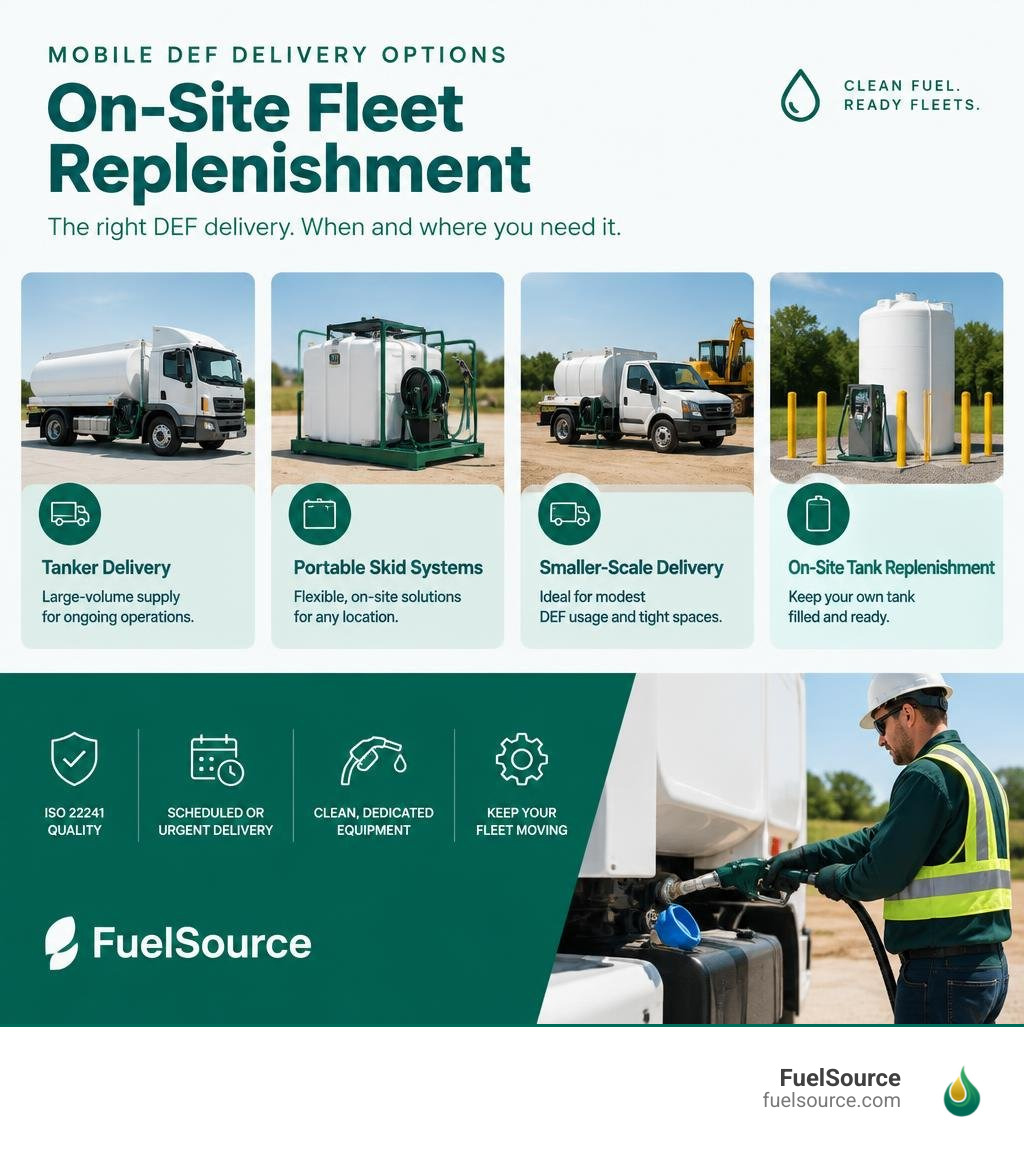
Fleet managers generally select between two primary mobile delivery models: deploying stationary on-site bulk storage infrastructure (such as IBC totes or mini-bulk tanks) or utilizing direct-to-vehicle wet-hosing, where delivery trucks fill the fluid reservoirs of every piece of equipment in your yard or job site.
| Feature / Metric | On-Site Bulk Storage (Totes/Tanks) | Direct Mobile Wet-Hosing |
|---|---|---|
| Typical Capacity Range | 200 – 330 gallon IBC totes; 500 – 1,000+ gal mini-bulk | Delivered directly into 5 – 25 gallon onboard vehicle tanks |
| Dispensing Flow Rates | 7 – 16 GPM via 12V or 110V dedicated electric pumps | 10 – 25 GPM metered commercial delivery reels |
| Yard Footprint | Requires dedicated, clean, protected space in yard | Zero stationary footprint required |
| Driver & Labor Requirements | Fleet drivers/yard techs handle daily dispensing | Service technicians manage 100% of the fueling process |
| Capital Investment | Investment in secondary containment, pumps, and reels | Zero equipment purchasing; pay only for delivered fluid |
| Contamination Risk | Moderate (open caps, nozzle drops, dust ingress) | Lowest (direct closed-loop injection by trained technicians) |
Flow Rates, Pump Specifications, and Scheduled Replenishment
Efficient DEF handling requires calibrated pump systems designed specifically for fluid viscosity and vehicle tank inlet restrictions:
- Standard-Flow Systems (7–10 GPM): Ideal for day-cab tractors, box trucks, and light utility machinery with 5- to 10-gallon DEF reservoirs, operating at approximately 25 psi to eliminate foaming.
- High-Flow Transfer Systems (15–16 GPM): Used for bulk tote-to-vehicle transfers and large earthmoving equipment carrying 20- to 40-gallon onboard DEF tanks.
- Automated Multi-Engine Replenishment Systems: Stationary generators and continuous-duty Tier 4 Final power units on infrastructure projects utilize automated 300-gallon replenishment systems. These units read engine fluid levels via CANBUS integration, automatically pumping fluid to keep multiple engines running around the clock without manual intervention.
Financial and Operational Advantages Over Retail Jugs and Cardlocks
Relying on off-the-shelf 2.5-gallon jugs from retail truck stops or cardlocks creates an invisible, compounding drag on fleet profitability. Retail jugs represent one of the highest markups in fleet maintenance, driven by the packaging, retail shelf space, and freight costs of transporting individual plastic containers.
Transitioning to the strategic fleet manager approach to mobile fluid management cuts out intermediate retail costs while protecting productive driver hours.
Calculating the ROI of Mobile DEF Refueling vs. Retail Stops
The financial return on bulk mobile delivery becomes obvious when comparing unit fluid costs alongside labor recovery.
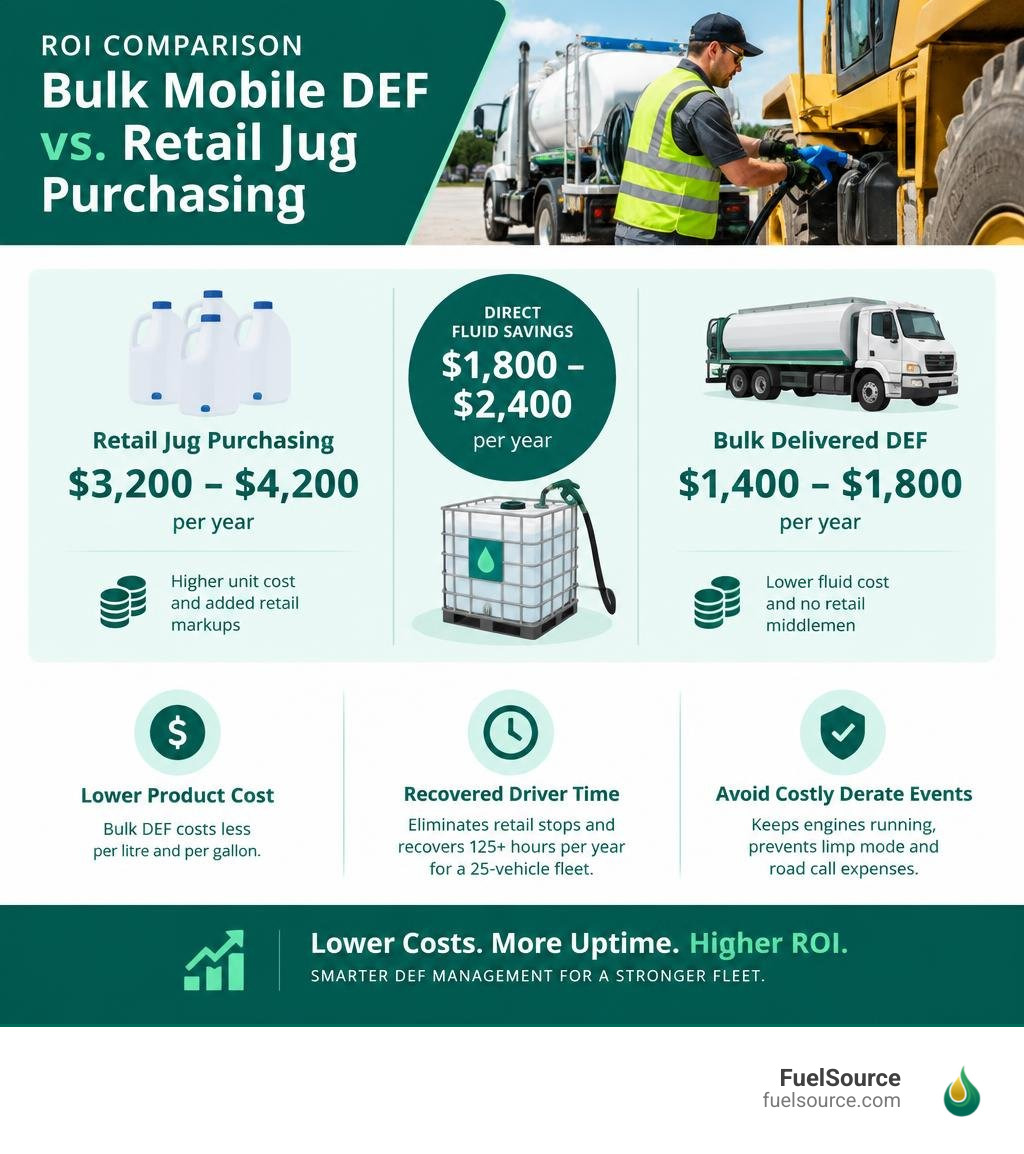
- Direct Product Price Reduction: Delivered bulk DEF averages approximately $0.70 to $0.90 per litre (roughly $2.65 to $3.40 per gallon), compared to retail jugs which consistently cost $1.60 to $2.10 per litre (equivalent to $6.00 to $8.00 per gallon or $15.00 to $20.00 per 2.5-gallon jug).
- Elimination of Labor Waste: Every retail stop to purchase and pour jugs consumes 10 to 15 minutes of driver time. For a 25-vehicle fleet, shifting to yard-based delivery recovers over 125 productive driving hours annually.
- Prevention of Costly Derate Events: When an SCR system detects an empty DEF tank, modern ECMs restrict engine torque by up to 40%, eventually locking the truck into a 5 MPH limp mode. Avoiding a single emergency road call or tow easily saves $500 to $1,500 per incident.
Fleet managers can see how smart fleet operations eliminate wasted yard hours by consolidating fuel and DEF procurement into a single automated routine.
Protecting SCR Systems: Contamination Control and Winter Storage Best Practices
DEF purity must be strictly preserved. The fluid maintains a eutectic concentration of 32.5% urea, engineered to have the lowest possible freezing point at 12°F (-11°C).
When managing fluid in variable weather conditions across North Georgia, adherence to clean handling protocols is essential:
- Deionized Water Integrity: Never attempt to dilute concentrated DEF or top off a tank with tap water. Minerals present in municipal water immediately foul the internal optical quality sensors and exhaust injectors.
- Winter Fluid Management: DEF expands by approximately 7% upon freezing. High-density polyethylene tanks and delivery reels must incorporate expansion headroom and thermal insulation to prevent casing stress during freezing conditions.
- Freeze-Thaw Stability: DEF can freeze solid at 12°F without degrading its chemical composition. Once thawed naturally or via vehicle heating elements, the urea-water balance remains completely intact and immediately functional.
For construction crews navigating rugged terrain, managing DEF handling for heavy construction machinery requires using closed, sealed connections to keep red Georgia clay and silica dust out of sensitive machine tanks.
Industry Applications: From Active Job Sites to Agricultural Fields

Mobile DEF delivery delivers significant operational value across commercial sectors that operate capital-intensive, Tier 4 Final equipment in off-road, high-demand settings.
Operational Benefits of Mobile DEF Refueling for Heavy Equipment
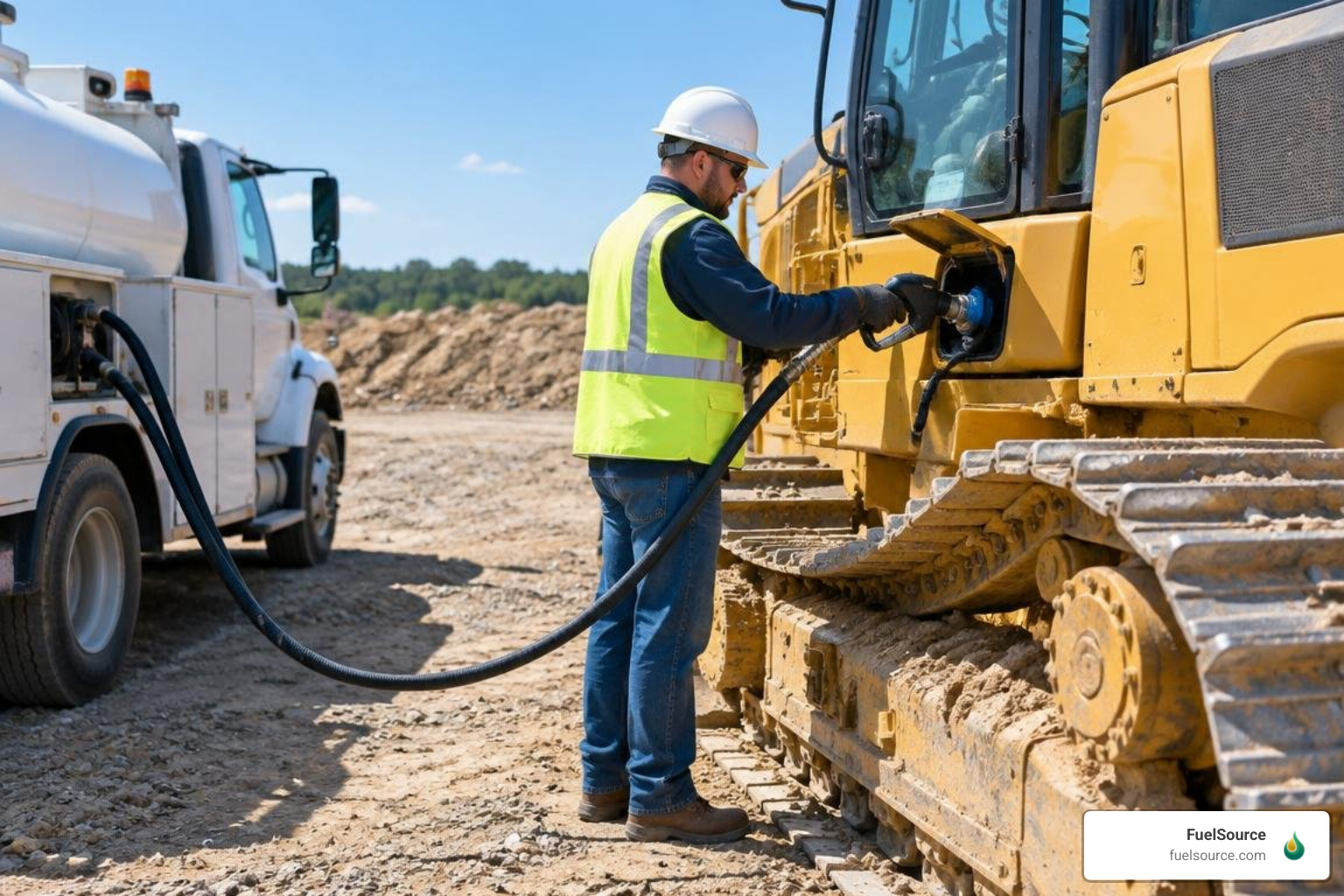
Civil excavation, grading, and paving operations rely on excavators, bulldozers, wheel loaders, and articulated dump trucks scattered across sprawling job sites. Moving a 40-ton excavator across rough terrain to reach a stationary fluid tank wastes track life, burns diesel, and risks site accidents.
Mobile wet-hosing trucks travel directly to each machine during scheduled shift changes or overnight staging windows. Implementing comprehensive DEF management for off-road machinery ensures your heavy iron starts the workday with topped-off fluid tanks and full engine power.
Logistics Fleets, Landscaping, and Municipal Service Optimization
- Logistics & Distribution Yards: High-throughput freight carriers running terminal tractors and line-haul rigs require fast turnaround times. Direct wet-hosing fills both diesel tanks and DEF reservoirs while trucks are staged at loading docks.
- Commercial Landscaping Operations: Landscaping contractors running commercial medium-duty trucks and diesel mowers benefit from dedicated route and landscaping DEF delivery solutions, ensuring trucks roll out every morning ready for scheduled customer routes.
- Agricultural Operations: During tight planting and harvesting windows, tractors and combine harvesters run long hours. Utilizing mobile DEF delivery for modern farming operations brings bulk ISO-certified fluid directly to the field edge, eliminating trips back to the farm headquarters.
- Municipal and Utility Fleets: Emergency service vehicles, refuse trucks, and transit buses rely on scheduled yard replenishment to guarantee zero downtime during emergency responses and severe weather events.
Frequently Asked Questions About Mobile DEF Refueling
How does mobile DEF delivery prevent engine derate and limp mode?
Modern diesel engines monitor DEF tank levels and fluid quality in real time via electronic sensors. When DEF levels drop below 10%, the engine control module triggers dashboard alerts, followed by escalating engine torque derates (often reducing engine power by 25% to 40%). If the tank runs completely dry, the engine enters an irreversible limp mode (limiting speeds to 5 MPH) until DEF is replenished and the fault clears.
Scheduled mobile DEF delivery creates a proactive refill cycle based on your fleet’s diesel consumption, ensuring tanks are topped off before reaching warning thresholds.
How do mobile DEF systems handle freezing temperatures in winter?
DEF freezes at 12°F (-11°C). Mobile delivery units operating in cold weather utilize thermally insulated tank enclosures, integrated 12V/120V heating blankets, and freeze-rated EPDM dispensing hoses to keep fluid flowing smoothly.
Because DEF expands by approximately 7% when frozen, storage tanks are engineered with expansion space to prevent structural stress. Once thawed, DEF does not separate or lose its chemical efficacy.
What hardware is required to receive mobile DEF on-site?
If you opt for direct-to-vehicle mobile wet-hosing, your facility requires zero additional hardware. The delivery provider supplies the delivery truck, calibrated positive-displacement pumps, long-reach EPDM hoses, and non-drip stainless steel nozzles.
If your facility chooses on-site bulk storage, your provider can deliver pre-assembled, turn-key IBC totes or mini-bulk tanks equipped with dedicated electric pumps, 20-foot dispense hoses, and smart telemetry level monitors that automatically trigger refill dispatches.
Boost Your Fleet Efficiency with FuelSource
Managing DEF logistics should never distract you from your core commercial operations. Transitioning from expensive retail jugs and ad-hoc driver stops to scheduled mobile DEF delivery immediately lowers per-gallon fluid expenses, recovers valuable driver hours, and protects your engines from expensive SCR contamination.
At FuelSource, we bring more than 30 years of fuel delivery expertise to commercial operations across Atlanta and North Georgia, including Fulton, Gwinnett, Cobb, DeKalb, Cherokee, and Forsyth counties. Whether your business requires direct machine wet-hosing on an active grading project or bulk tote replenishment at your distribution terminal, our custom-built delivery trucks ensure ISO 22241-certified purity on every drop.
Combined with our easy-to-use customer portal for instant delivery reporting and automated IFTA tax tracking, we provide comprehensive, reliable fuel delivery for fleets designed to keep your business moving forward.
Ready to streamline your fleet fluid logistics? Contact our team today to schedule reliable turn-key mobile DEF fluid delivery for your yard or job site.