
What Are IFTA Compliant Fuel Reports — and Why They Matter in 2026
IFTA compliant fuel reports are the quarterly tax filings that interstate motor carriers must submit to their base jurisdiction, detailing miles traveled and fuel purchased in every participating state and Canadian province.
Here’s what you need to know at a glance:
| Topic | Quick Answer |
|---|---|
| What they are | Quarterly fuel tax reports filed with your base state |
| Who must file | Carriers with vehicles over 26,000 lbs GVW or 3+ axles operating in 2+ jurisdictions |
| When they’re due | April 30, July 31, October 31, and January 31 |
| What’s included | Miles per jurisdiction, fuel purchased, MPG, and tax owed or credited |
| Late penalty | $50 or 10% of net tax liability — whichever is greater |
| Record retention | 4 years from the due date or filing date, whichever is later |
If you run a fleet of trucks, construction equipment, or farm vehicles across state lines, IFTA was actually designed to help you. Before IFTA, carriers had to file a separate fuel tax return with every single state they drove through. Now, you file once — with your home state — and that jurisdiction handles distributing the tax revenue to everyone else.
Simple in theory. But the reporting itself still has a lot of moving parts.
Getting the numbers wrong — or missing a deadline — can trigger penalties, interest charges, and even an audit. Base jurisdictions audit roughly 3% of IFTA licenses each year, with a specific focus on accounts that show unusually high or low mileage.
I’m Kyle Behnke, and through my work with FuelSource in the Atlanta area, I’ve seen how IFTA reporting headaches — especially around fuel tracking and documentation — are one of the biggest pain points for fleet operators in construction, logistics, and agriculture. Understanding how to generate accurate IFTA compliant fuel reports is the first step to staying compliant and keeping your operation moving. Let’s break it all down.
Understanding the International Fuel Tax Agreement (IFTA)
To understand why we need IFTA compliant fuel reports, we first have to look at the agreement itself. The International Fuel Tax Agreement is a “pay-as-you-go” system for road maintenance. Since heavy trucks cause more wear and tear on roads, states want to ensure they get their fair share of tax revenue based on exactly how many miles you drive on their pavement.
Currently, IFTA includes the 48 contiguous United States and 10 Canadian provinces. If you are based here in Georgia—whether your headquarters is in Marietta, Decatur, or downtown Atlanta—Georgia is your “base jurisdiction.” You register for your license here, and you file your reports here.
The beauty of this system is that it consolidates everything. Instead of dealing with 58 different agencies, you deal with one. However, this convenience comes with a strict requirement for accuracy. Every gallon of diesel or gasoline must be accounted for to ensure the tax dollars are distributed correctly. If you’re looking to streamline how your fleet gets that fuel in the first place, our Fleet Fueling Services can help simplify the data collection process from the start.
For more technical details on the agreement, you can visit the International Fuel Tax Agreement – IFTA resource page.
Vehicle Requirements and Exemptions
Not every truck on the road needs to worry about IFTA. The agreement specifically targets “Qualified Motor Vehicles.” In the eyes of the law in 2026, a vehicle qualifies if it is used, designed, or maintained for the transportation of persons or property and meets one of these criteria:
- Weight: It has a gross vehicle weight (GVW) or registered gross vehicle weight exceeding 26,000 pounds (11,797 kg).
- Axles: It has three or more axles, regardless of weight.
- Combination: It is used in combination, and the actual or registered weight of the combination exceeds 26,000 pounds.
Basically, if it’s a heavy-duty hauler, it’s probably an IFTA vehicle. However, there are some “free passes.” Recreational vehicles, like that motorhome you take up to the North Georgia mountains for the weekend, are generally exempt if used exclusively for personal pleasure.
It’s also important to note where IFTA doesn’t reach. If you drive into Hawaii or Alaska, those miles aren’t part of your IFTA report. The same goes for Mexican states and certain Canadian territories like the Yukon or Northwest Territories. If your fleet operates in these areas, those miles are considered “non-IFTA miles” and must be categorized separately on your IFTA compliant fuel reports.

Essential Components of IFTA Compliant Fuel Reports
Creating IFTA compliant fuel reports isn’t just about guessing how much fuel you used. It requires a meticulous breakdown of data. When we help our clients in Bartow or Cherokee County with their fuel data, we emphasize that the report must prove where every drop of fuel went.
A standard report includes:
- Total IFTA Miles: Every mile driven in a participating jurisdiction.
- Total Non-IFTA Miles: Miles driven in places like Mexico or DC.
- Total Gallons: Every gallon of fuel put into the tanks of qualified vehicles.
- Jurisdiction Breakdown: A line-by-line list of miles and fuel for each state or province.
To help visualize the difference, look at how miles are categorized:
| Mile Type | Includes | Tax Impact |
|---|---|---|
| Taxable Miles | Most highway miles in IFTA jurisdictions | Full tax rate applies |
| Non-Taxable Miles | Miles in non-IFTA states or certain off-road use (varies by state) | No IFTA tax, but may require proof |
| Total Miles | The sum of all miles driven anywhere | Used to calculate your fleet’s MPG |
For a deeper dive into what your specific jurisdiction might require, check out the IFTA Licenses Reporting guide.
Maintaining Records for IFTA Compliant Fuel Reports
If there is one thing that keeps fleet managers in Fulton or Gwinnett County awake at night, it’s the thought of an IFTA audit. The only defense against an audit is a paper (or digital) trail that is “bulletproof.”
You must maintain records for four years from the date the return was filed. This is significantly longer than the six months required by the DOT or FMCSA for other records. If you lose your receipts from 2024, and it’s currently April 2026, you could still be in trouble if an auditor comes knocking.
Key records include:
- Odometer Readings: Start and stop readings for every trip.
- Fuel Receipts: These must show the date, fuel type, number of gallons, and the location of the purchase.
- Bulk Storage Withdrawals: If you have fuel tanks on-site in Paulding or Forsyth County, you must track every gallon taken from the bulk tank and put into a specific truck.
- GPS Tracking: Many modern fleets use ELDs (Electronic Logging Devices) to track distance. This is much more accurate than manual logs and is highly preferred by auditors.
At FuelSource, we know that tracking fuel is a chore. That’s why our diesel delivery services are designed to provide clear, digital documentation that makes your record-keeping much easier.
Calculating MPG and Tax Liability
The “magic number” in any IFTA report is your Average Fleet MPG. This number determines how much tax you owe to each state.
The formula is simple: Total Fleet Miles ÷ Total Gallons Consumed = Average MPG
Once you have your MPG, you apply it to each state. For example, if you drove 1,000 miles in South Carolina and your fleet average is 5.0 MPG, South Carolina “expects” that you used 200 gallons of fuel there. If you only bought 100 gallons in South Carolina, you owe them tax on the remaining 100 gallons. If you bought 300 gallons there, you get a tax credit!
It sounds like a lot of math—and it is. This is why many carriers use the Form 3150 Instructions as a template for their calculations, even if they are filing in Georgia, as the logic remains the same across the board.
Deadlines, Penalties, and Record-Keeping Requirements
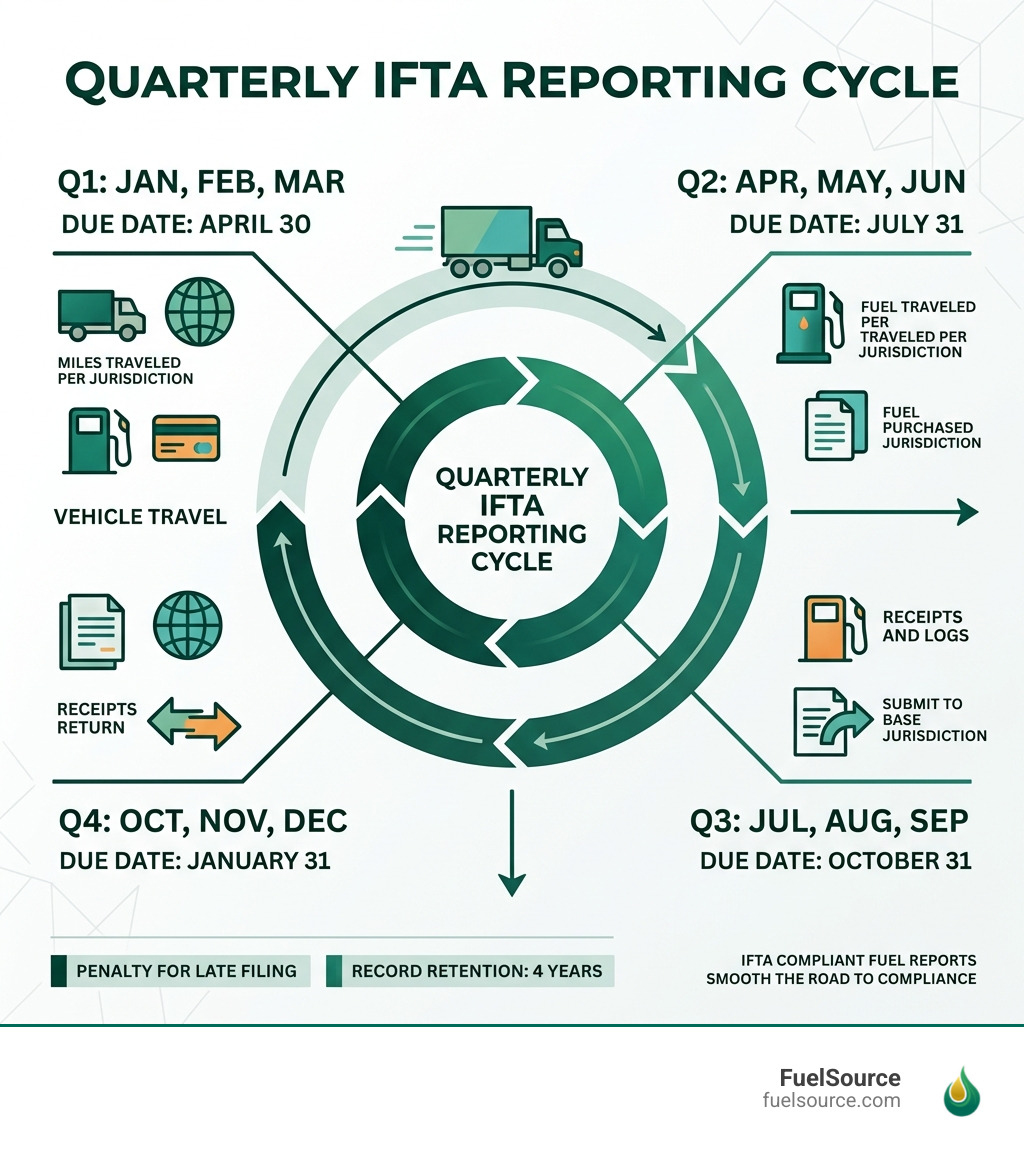
In IFTA, being fashionably late is an expensive mistake. The reporting year is divided into four quarters, and your IFTA compliant fuel reports are due by the last day of the month following the end of the quarter.
For 2026, mark these dates on your calendar:
- Q1 (Jan-Mar): Due April 30, 2026
- Q2 (Apr-Jun): Due July 31, 2026
- Q3 (Jul-Sep): Due October 31, 2026
- Q4 (Oct-Dec): Due January 31, 2027
Even if your trucks didn’t leave the yard in Cobb or Douglas County for the entire quarter, you must file a “Zero Operation” report. Failing to file at all is a red flag that often leads to a “best estimate” assessment by the state—which is never in your favor.

Late Filing Consequences and Interest
What happens if you miss the deadline? The penalties are designed to be a deterrent. Most jurisdictions, including Georgia, charge a flat fee of $50 or 10% of the net tax liability, whichever is greater.
But it doesn’t stop there. You will also be charged interest on any delinquent taxes. As of 2026, the standard interest rate is 1% per month. If you owe $1,000 in fuel tax and you’re six months late, you’ve just added a significant chunk to your bill.
Beyond the money, late filing puts your IFTA license at risk. If your license is revoked, your trucks are grounded. You can’t legally operate in interstate commerce without those decals. For more tips on keeping your fleet running smoothly and avoiding these pitfalls, check out our fleet management resources.
How to File Your Quarterly Reports
Most carriers in the Atlanta Metro area now file their reports online. Georgia, like many other states, has moved away from paper to speed up the process and reduce errors.
When you log into your base jurisdiction’s portal, you’ll enter your total miles and fuel for each state. The system usually calculates the tax or credit for you based on the current rates. Fuel tax rates change frequently! Some states might raise their tax by a few cents in the middle of a quarter, and an online system will automatically account for that.
If you prefer a more manual approach or need a worksheet to organize your data before hitting “submit,” you can often use a File Quarterly IFTA Fuel Tax Online service or refer to standard forms like the 3150.
To make the filing process even easier, consider how you get your fuel. Our on-site fueling solutions provide you with instant digital reports. Instead of chasing down drivers for crumpled receipts from a truck stop in Henry County, you get a clean report of every gallon delivered directly to your equipment.
IFTA vs. IRP: Understanding the Difference
We often get asked by new fleet owners in Rockdale or Walton County about the difference between IFTA and IRP. They both involve interstate travel, but they cover different things.
- IFTA (International Fuel Tax Agreement): This is all about fuel. It ensures each state gets its fair share of fuel tax.
- IRP (International Registration Plan): This is all about registration fees. It distributes your license plate fees among the states based on the percentage of miles you drive in each one.
You need both to be compliant. Think of IRP as your permission to drive in other states and IFTA as your way of paying for the “gas” you use while you’re there. If you’re ready to get your fleet moving and need a reliable partner, you can order fuel for your fleet today.
Frequently Asked Questions about IFTA Compliant Fuel Reports
How long must I keep my fuel and mileage records?
As we mentioned earlier, the rule is four years. This includes your GPS data, odometer logs, and every single fuel receipt. If you are audited, the auditor will ask for these records to verify the numbers on your IFTA compliant fuel reports. Pro tip: Digital copies are your best friend! Scan those receipts before the ink fades.
What happens if I don’t operate my vehicles during a quarter?
You still have to file! This is a “Zero Operation” report. If you have an active IFTA license and decals, the state expects a report every quarter. If you stop filing, they will assume you are still operating but hiding the data, which is a one-way ticket to an audit.
Are fuel tax holidays included in IFTA calculations?
Yes, and they are a massive headache for manual filers. Occasionally, a state like Georgia might declare a “fuel tax holiday” to provide relief at the pump. During these periods, you don’t pay the state tax at the time of purchase. However, you still have to report those miles and gallons. Your reporting software or the state’s online portal will usually have specific instructions on how to handle these dates to ensure you aren’t overcharged or under-credited.
Conclusion
Staying on top of IFTA compliant fuel reports is a fundamental part of running a successful interstate fleet. While the math and the record-keeping can feel overwhelming, the system is ultimately there to simplify your administrative life. By keeping accurate logs, filing on time, and maintaining your records for the required four years, you can protect your business from unnecessary penalties and the stress of an audit.
At FuelSource, we’ve spent over 30 years helping fleets across the Atlanta Metro and North Georgia—from Bartow County to Fayette County—stay fueled and compliant. Our state-of-the-art equipment and dedicated customer portal provide you with the instant reports you need to make IFTA filing a breeze.
Whether you’re running a construction site in Canton or a transportation fleet in Marietta, we’re here to take the “fuel stress” off your plate. Ready to simplify your fleet management? Get started with our Fleet Fueling Services today and see the difference that professional, automated reporting can make for your bottom line.