Why Diesel Delivery for Heavy Machinery Is a Game-Changer for Your Operation
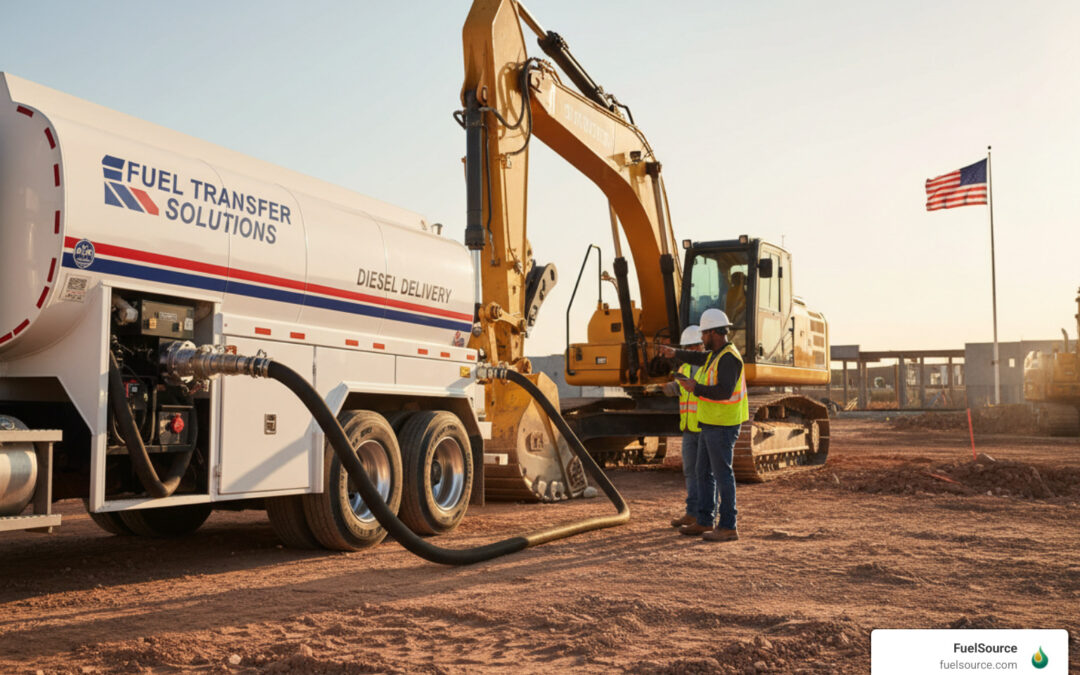
Diesel delivery for heavy machinery means a licensed fuel provider drives directly to your job site, farm, or facility and pumps diesel into your equipment — no hauling machines to a gas station, no jerry cans, no downtime.
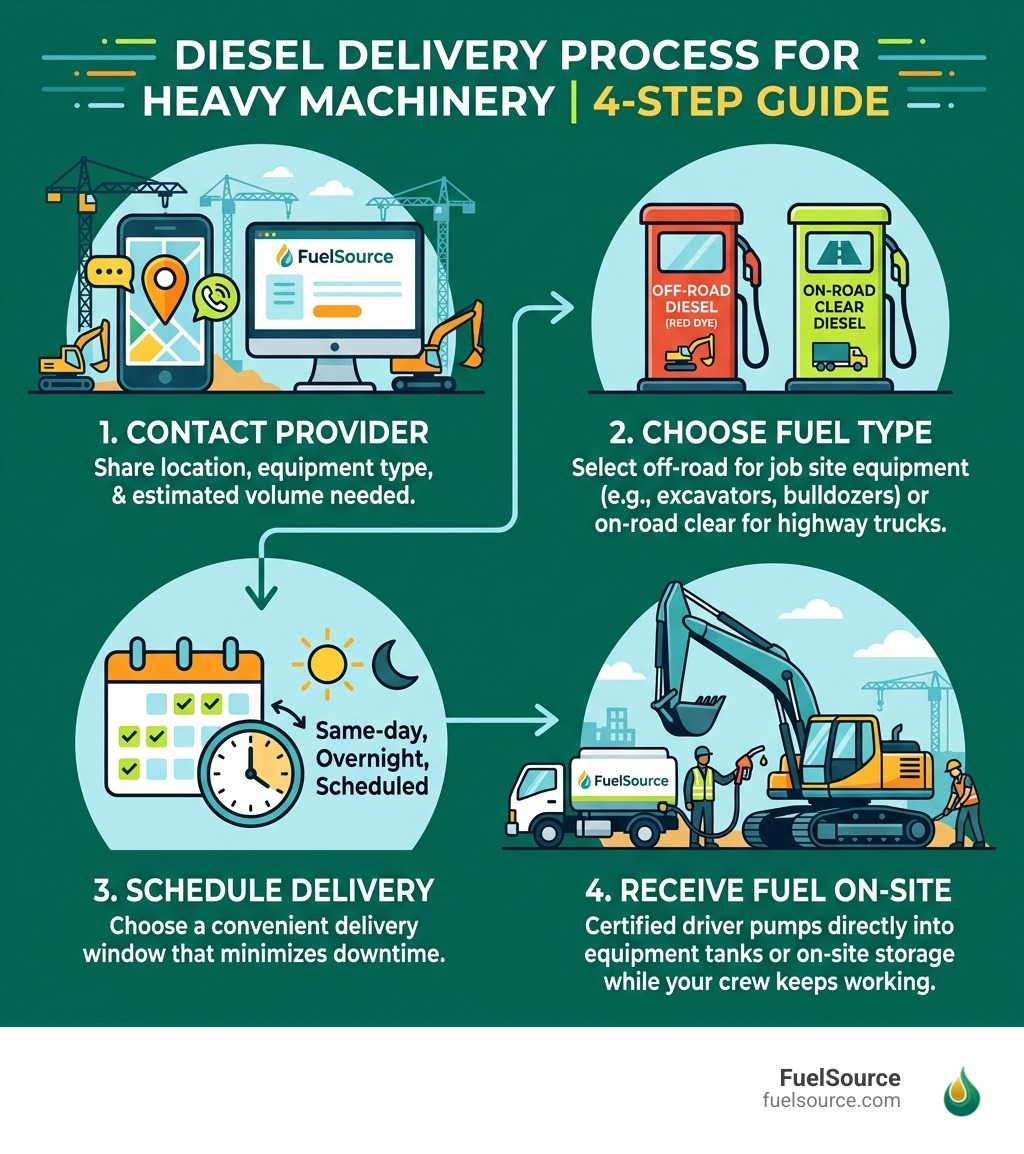
Here’s how to arrange on-site diesel delivery in four steps:
- Contact a fuel delivery provider and share your location, equipment type, and estimated fuel volume needed.
- Choose your fuel type — off-road (red dye) diesel for excavators, bulldozers, and generators, or on-road clear diesel for highway trucks.
- Schedule a delivery window — most providers offer same-day, overnight, or recurring scheduled service.
- Receive fuel on-site — a certified driver pumps directly into your equipment tanks or on-site storage tank while your crew keeps working.
Diesel is the lifeblood of construction, agriculture, and industrial operations. Excavators, bulldozers, generators, cranes — none of them move without it.
The problem? Getting fuel to the machine is often harder than the job itself. Sending a driver off-site to fill up costs hours. Running dry mid-shift costs even more.
That’s why more fleet managers and business owners across construction, farming, and logistics are switching to on-site diesel delivery — fuel that comes to the equipment, not the other way around. Providers like FuelSource can deliver anywhere from small loads under 100 gallons to bulk shipments of thousands of gallons, including tight spots like parking garages or remote rural job sites.
This guide covers everything you need to know: fuel types, equipment, compliance, ROI, and how to set up reliable diesel delivery for your operation.
The Logistics of Diesel Delivery Heavy Machinery
When we talk about diesel delivery heavy machinery, we are looking at a precision logistics operation. It isn’t just about driving a truck to a site; it’s about getting the right fuel into the right tank at the right time. For most heavy-duty applications in Georgia—whether you’re clearing land in Cherokee County or running a high-rise construction project in downtown Atlanta—this involves a mix of off-road and on-road fuels.
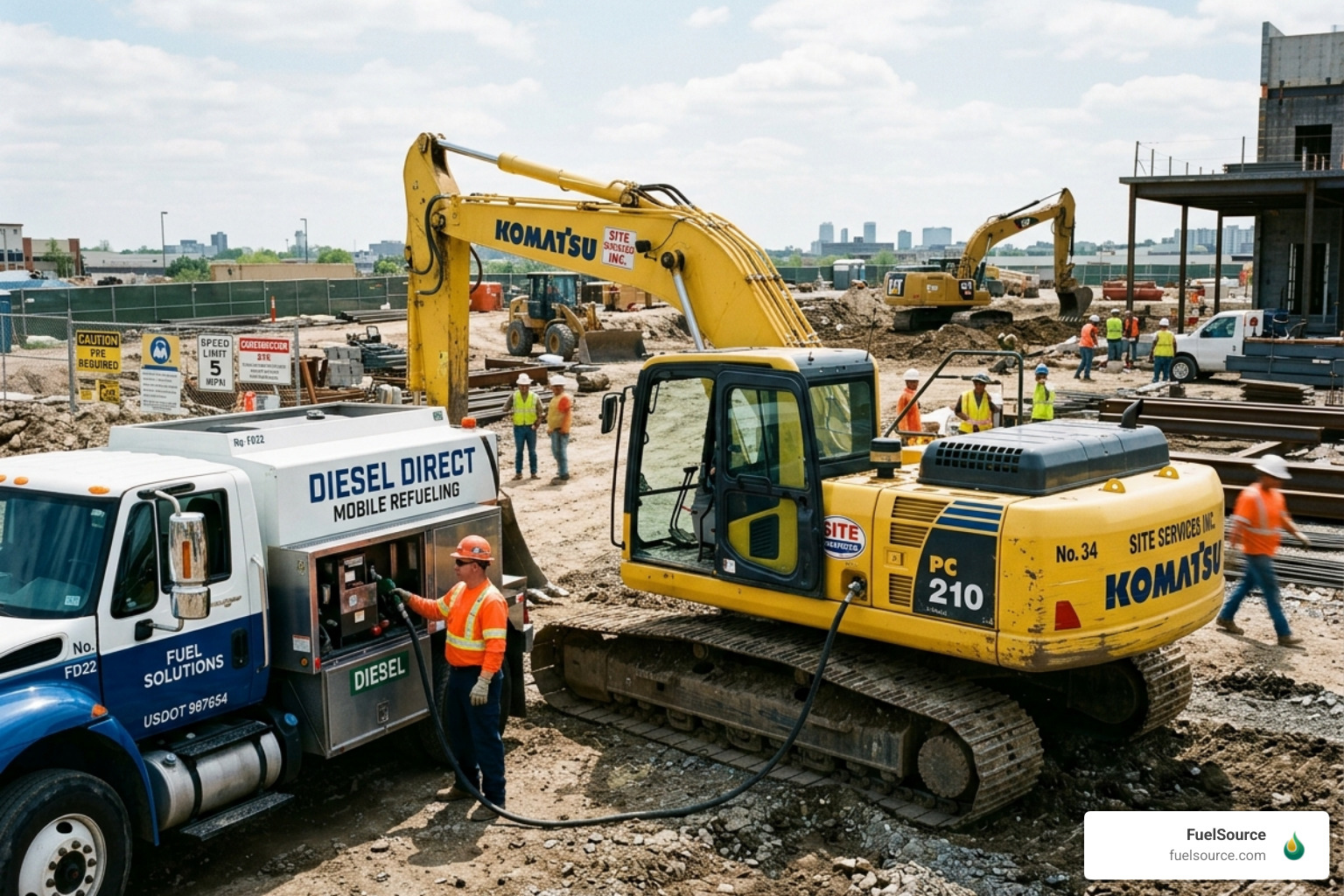
The primary fuel for “yellow iron” (bulldozers, excavators, and loaders) is off-road diesel, also known as dyed diesel. This fuel is chemically identical to the clear diesel you buy at a gas station, but it contains a red dye to signify that it is tax-exempt for non-highway use. Because these machines aren’t putting wear and tear on Georgia’s public roads, you don’t have to pay the road tax, which can save your operation a significant amount of money over a long project.
However, some machinery requires clear diesel (on-road). This is typically used for equipment that might occasionally travel on public roads or for specialized trucks that support the job site. Both types are Ultra-Low Sulfur Diesel (ULSD), meaning they meet modern environmental standards to keep your engines running cleanly and efficiently. For more details on how these services are structured, you can explore our on-site fueling services.
Specialized Equipment for Diesel Delivery Heavy Machinery
Not every job site is a wide-open field. We often encounter “tight-squeeze” scenarios—think of a backup generator located on the fourth floor of a parking garage in Decatur or a skid steer working in a narrow alley in Marietta. To handle this, a professional mobile fuel delivery service uses a variety of vehicle sizes:
- Bobtails: These are the workhorses of the industry. Typically hauling around 4,500 gallons, they are large enough to handle bulk needs but small enough to navigate most suburban construction sites.
- Pickup Trucks and Fuel Trailers: For those truly difficult spots, we utilize specialized pickup trucks equipped with 350-gallon tanks or 1,000-gallon fuel trailers. These are perfect for small-scale deliveries or reaching equipment in height-restricted areas.
- Extended Reach: High-quality delivery trucks come equipped with over 100 feet of hose and specialized x fittings. This allows us to reach fuel ports that are tucked away behind other equipment or located deep within a structure.
Essential Fuel Types and DEF
In April 2026, modern heavy machinery is more advanced than ever. To meet EPA Tier 4 emission standards, almost all new diesel engines require Diesel Exhaust Fluid (DEF). If your excavator runs out of DEF, it will likely enter “limp mode,” significantly reducing power or even shutting down entirely to prevent emissions violations.
We provide DEF fluid delivery alongside our diesel services. This ensures your machines stay compliant with ISO 22241 standards. Furthermore, the diesel we deliver often includes specialized additives like rust inhibitors and detergents. These help prevent the growth of microbes in the tank and keep fuel injectors clean, which is vital for preventing downtime in the humid Georgia climate.
Strategic Benefits of On-Site Refueling
The most immediate benefit of diesel delivery heavy machinery is the sheer reduction in downtime. Think about the “soft costs” of refueling. If a machine operator has to stop work, track down a fuel trailer, or wait for a slow hand pump, you aren’t just losing fuel—you’re losing productive labor hours.
Wet hosing, or direct-to-equipment fueling, is the gold standard for efficiency. Instead of filling a large stationary tank on your site, we go machine-to-machine, filling each tank directly. This is often done during “off-hours” or at night, meaning when your crew arrives at 6:00 AM in Gwinnett County, every piece of equipment is topped off and ready to roar. To understand why this is so critical for local businesses, read more about why Atlanta mobile fuel delivery services are the lifeblood of Georgia business.
Calculating ROI for Diesel Delivery Heavy Machinery
Many small demolition or landscaping companies wonder if they are “big enough” for professional delivery. The reality is that even small-scale operations see a return on investment almost immediately.
| Refueling Method | Labor Cost | Equipment Wear | Fuel Security |
|---|---|---|---|
| Traditional (Self-Refuel) | High (Staff spends time hauling fuel) | High (Idle time, extra transport) | Low (Theft/Spillage risk) |
| On-Site Delivery | Zero (Fueling happens during downtime) | Low (Engines stay productive) | High (Digital tracking/Metered) |
For a small company, the cost of a high-quality 1,000-gallon fuel trailer can range from $15,000 to $30,000 depending on features. However, when you factor in the bulk pricing we can offer—compared to retail prices at the pump—and the elimination of “fuel runs,” the equipment often pays for itself within the first year of a major project.
Mobile Fuel Delivery and Logistics
Managing a fleet requires more than just fuel; it requires data. Whether you are managing a dozen dump trucks or a hundred pieces of earth-moving equipment, mobile fuel delivery provides the oversight you need. We offer scheduled routes that sync with your operational heartbeat.
If you have a sudden surge in work or an emergency—like a hospital generator needing a top-off during a North Georgia storm—emergency refueling services ensure you are never left in the dark. Our fleet fueling services are designed to provide this level of reliability 24/7/365.
Compliance, Safety, and Advanced Fuel Management
Safety is the non-negotiable part of diesel delivery heavy machinery. Handling hazardous materials requires strict adherence to EPA and DOT regulations. Our technicians are Hazmat-trained and OSHA-certified, ensuring that every drop of fuel goes into the tank and nowhere else.
Spill prevention is a major part of the job. We use containment mats, grounding cables to prevent static discharge, and constant oversight during the transfer process. This isn’t just about safety; it’s about protecting your business from the massive fines associated with environmental contamination.
Permits and Regulatory Standards
Using off-road diesel requires specific state permits to maintain your tax-exempt status. We simplify this through our digital verification and audit trails. Every delivery is metered and logged with GPS-timestamped records. This is a lifesaver when it comes to IFTA reporting or internal bookkeeping. By using certified Weights and Measures equipment, we guarantee that you get exactly what you pay for, down to the tenth of a gallon.
Tank Rentals and Remote Monitoring
Sometimes, the best solution isn’t just direct fueling, but having a “buffer” on-site. We provide fuel tank rentals ranging from 500 to 5,000 gallons. These are EPA-compliant, above-ground storage tanks that can be dropped at your site and picked up when the job is done.
The “magic” happens with remote tank monitoring. We can install sensors on your tanks that alert us when levels hit a certain threshold (e.g., 30%). This triggers an automatic refill, meaning you never have to pick up the phone to order fuel. It’s “set it and forget it” logistics for the modern job site.
Frequently Asked Questions about Diesel Delivery
Is off-road diesel lower quality than on-road diesel?
Absolutely not. Chemically, they are identical. Both are Ultra-Low Sulfur Diesel (ULSD) that meet ASTM D975 specifications. The only difference is the red dye. Your high-performance Caterpillar or John Deere engines will run exactly the same on dyed diesel as they would on clear diesel—you just save money on the taxes.
What is the minimum order for on-site diesel delivery?
While some companies only deal in thousands of gallons, we understand the needs of smaller sites. Many providers accommodate deliveries of 100 gallons or more. For specialized emergency needs, some companies can even handle small amounts like 20 gallons, though bulk shipments (500+ gallons) offer the best price-per-gallon value.
Can I use dyed diesel in my highway vehicles?
No. This is a major legal violation. Dyed diesel is strictly for off-road equipment, generators, and marine use. If the Georgia Department of Transportation or the IRS dips your tank and finds red dye in a highway vehicle, the fines can exceed $10,000 per occurrence. It is considered tax evasion, so always keep your clear and dyed tanks clearly labeled.
Conclusion
In the world of Georgia construction and industry, you can’t afford to be slowed down by logistics. Diesel delivery heavy machinery is more than just a convenience; it is a strategic advantage that keeps your crew working and your overhead low.
At FuelSource, we bring over 30 years of experience to the Atlanta Metro and North Georgia areas. From the tight streets of Marietta to the sprawling job sites of Cherokee and Forsyth Counties, we provide the state-of-the-art equipment and veteran expertise your project deserves. Our customer portal offers instant reports and IFTA data, making your back-office work as smooth as your field operations.
Ready to fuel your success? Visit us at https://www.fuelsource.com/ and let’s get your machinery moving.