Why Every Fleet Manager Needs a Fleet Fueling Customer Portal
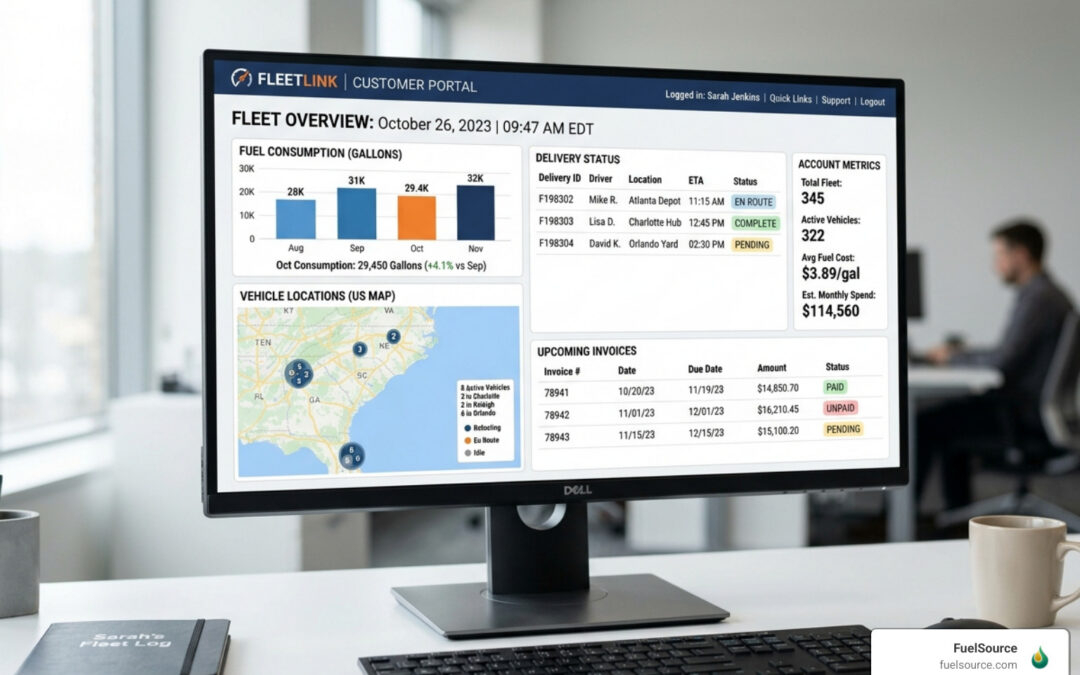
A fleet fueling customer portal is an online self-service platform that gives fleet managers, drivers, and accountants 24/7 access to fuel orders, delivery tracking, invoices, reports, and account controls — all in one place.
Here’s what you can typically do through a fleet fueling customer portal:
- Place and track fuel orders in real time, without calling your supplier
- Download invoices and delivery tickets instantly for accounting and compliance
- Set card controls like transaction limits, time restrictions, and driver PINs to prevent fraud
- Run customizable reports for fuel usage, costs, and IFTA tax compliance
- Manage users with different permission levels for drivers, managers, and accountants
- Receive automated notifications when order status changes
Think about it this way: your team can track a $15 pizza delivery in real time. Why should a $5,000 fuel order be any different?
For construction, farming, and logistics operations in the Atlanta metro and North Georgia, fuel downtime is expensive. A good portal puts you in control — before a shortage becomes a crisis.
I’m Kyle Behnke, a business professional at FuelSource with a background in operations and strategy from Emory University’s Goizueta Business School. My work in fleet fuel delivery for fleets has given me a front-row seat to how the right fleet fueling customer portal can cut administrative waste and keep equipment running. Let’s walk through exactly how these platforms work and what to look for.
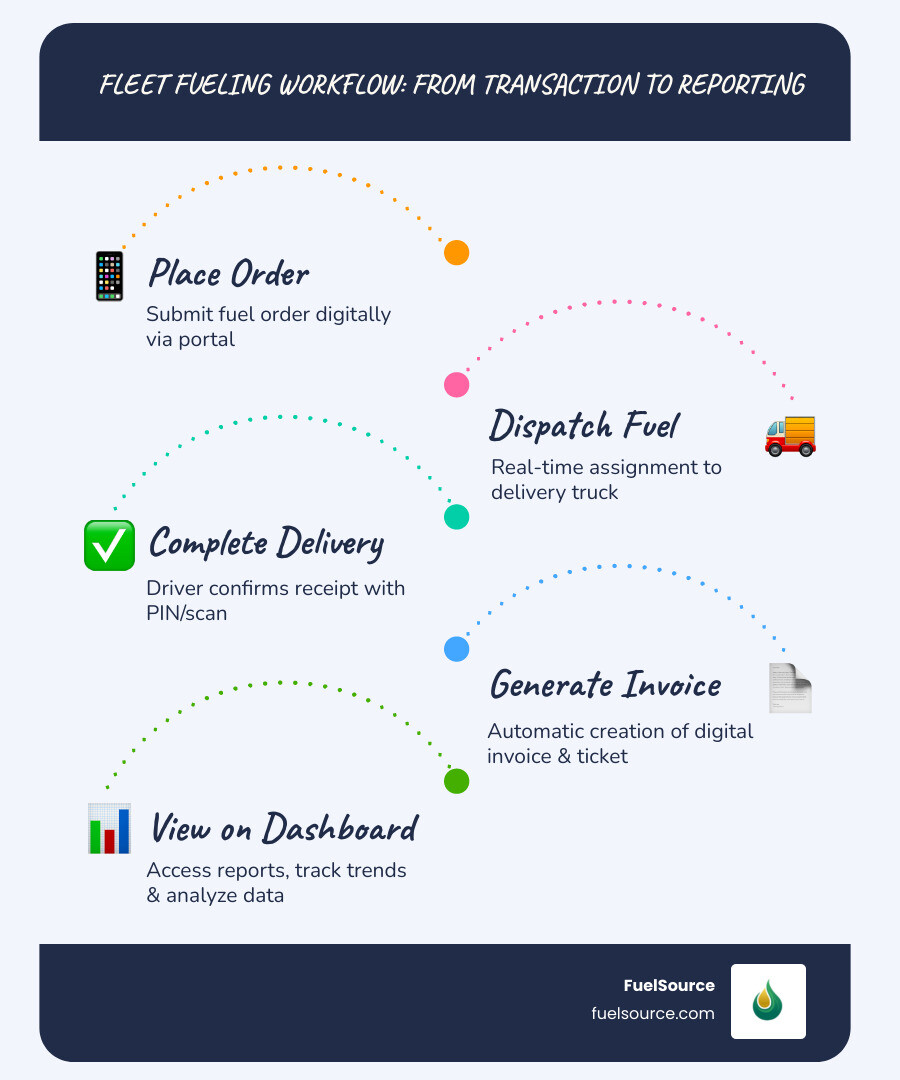
Simple fleet fueling customer portal word guide:
What is a Fleet Fueling Customer Portal?
At its core, a fleet fueling customer portal is a centralized, cloud-based hub designed to simplify the complex world of commercial fuel management. Instead of relying on a mountain of paper receipts, messy Excel spreadsheets, or endless back-and-forth phone calls with dispatchers, we provide a digital window into your entire fueling operation.

When you log in, you aren’t just looking at numbers; you are accessing real-time tracking of every drop of fuel delivered to your yard or job site. These portals consolidate data from Fleet Fueling Services into a single, user-friendly interface. Whether you are managing a handful of box trucks in Marietta or a massive construction fleet in Gwinnett County, the portal acts as your “mission control.”
Why a fleet fueling customer portal is essential for modern fleets
In the Georgia business environment, efficiency isn’t just a goal—it’s a requirement for survival. Modern Category Fleets face increasing pressure to reduce overhead and improve accuracy. A dedicated portal is essential because it addresses the “hidden” costs of fleet management:
- Order Accuracy: When your team enters the data directly into the portal, order accuracy hits 100%. No more miscommunications over the phone about which tank needs diesel and which needs unleaded.
- Reduced Status Calls: Research shows that self-service portals can lead to a 30% reduction in status calls. Your team doesn’t have to call us to ask, “Where’s the truck?” because they can see the status 24/7.
- Labor Savings: By automating order entry and document retrieval, businesses can save an estimated $15,300 annually in labor costs. That is time your staff can spend growing the business instead of chasing down delivery tickets.
- 24/7 Visibility: Whether it is 2:00 AM in Alpharetta or a holiday weekend in Decatur, you have instant access to your account data.
Improving security and fraud prevention through digital controls
Fuel is a liquid asset, and unfortunately, it can “evaporate” through theft or unauthorized use if not monitored closely. A robust fleet fueling customer portal serves as a digital fortress for your fuel budget.
Through the portal, we enable you to set granular controls that were impossible in the era of “cash and carry” fueling. You can assign driver-specific PIN codes for cardless authorization, ensuring that only authorized personnel can pump fuel. Furthermore, you can set transaction limits—restricting the total gallons per fill or the number of transactions per day.
If a truck is only supposed to run during business hours, you can set time and day restrictions. If a driver attempts to fuel a vehicle on a Sunday when your Paulding County site should be closed, the system can block the transaction and send a real-time email notification to your phone. This level of digital control is the most effective way to eliminate “slippage” and protect your bottom line.
Core Features for Enhanced Control and Security
A high-quality dashboard isn’t just about viewing data; it’s about active management. The best portals provide a suite of tools that allow you to customize how fuel flows through your organization.

When utilizing On-Site Fueling, the portal becomes the bridge between our delivery trucks and your back office. It allows for the implementation of “driver-proof” technology, such as laser scanning systems. By scanning a barcode on a specific unit, the system validates the fuel type before a single drop is dispensed. If a driver accidentally tries to put gasoline into a diesel unit, the pump won’t even turn on.
Managing user types from drivers to accountants
Not everyone in your company needs the same level of access. A well-designed fleet fueling customer portal supports various user roles to streamline administrative tasks:
- Fleet Managers: Have full visibility to order fuel, manage assets, and set security restrictions.
- Drivers: Can use mobile-optimized versions of the portal or integrated apps to select pumps, enter odometers, and complete fueling without needing a physical card.
- Accountants: Can skip the “manager’s desk” entirely and log in to retrieve VAT-compliant invoices, download transaction histories into Excel, and manage account balances.
This tiered access ensures that your accounting team gets the accuracy they need for expense control while your drivers stay focused on the road.
Real-time tracking and customizable reporting
Data is only useful if you can understand it. Modern portals use data visualization—like charts and graphs—to help you spot trends. Are your fuel costs spiking on Tuesdays? Is one driver consistently using more fuel than others for the same route?
Reporting is also the key to staying legal. We provide IFTA Compliant Fuel Reports and How to File Them directly through the portal. Instead of spending days manually calculating fuel taxes for different jurisdictions, you can generate a report in seconds that summarizes your gallons, prices, and locations. This is especially critical for fleets moving between Fulton, DeKalb, and Cobb counties, where clear record-keeping is a must for tax compliance.
Maximizing ROI with a Fleet Fueling Customer Portal
Investing in technology should always have a clear return. For most fleets in North Georgia, the ROI of a customer portal is demonstrated through significant time savings and improved cash flow.
When you understand Why On-Call Fuel Delivery is the Secret to Happy Fleet Managers, you realize that the portal is what makes that speed possible. It turns a manual, error-prone process into a streamlined digital workflow.
Streamlining invoicing and tax compliance
One of the biggest headaches for fleet accountants is reconciliation—matching delivery tickets to invoices. The portal eliminates this by providing instant access to digital delivery tickets as soon as the fuel is dropped.
- Digital Invoicing: Invoices can be processed as early as the next morning after a delivery, allowing for faster reconciliation and better cash flow management.
- Automatic Record Keeping: No more lost receipts. Every transaction is stored in the cloud with details like unit ID, date, time, and total gallons.
- Tax Refunds: Some systems even offer automatic tax refund features for fuel used in specific off-road applications (like construction equipment or reefers), which can result in thousands of dollars in annual savings.
Integration with ERP and fleet management tools
To truly maximize ROI, your fleet fueling customer portal shouldn’t be an island. It needs to talk to the software you already use. Many leading portals offer open API structures, allowing for seamless integration with:
- ERP & Accounting Software: Directly push fuel data into platforms like NetSuite, Cargas, or Salesforce.
- Fleet Management Tools: Sync odometer readings and fuel usage with your maintenance software to stay ahead of service intervals.
- Dispatch Systems: Ensure that when you Order Fuel, the information flows directly into your internal scheduling tools.
By connecting these systems, you eliminate double-entry and ensure that your entire business is operating from a single version of the truth.
Future Trends in Fleet Fueling Dashboards
The world of fuel management is moving toward “intelligent” systems. We are moving past simple data entry and into the era of predictive analytics.
As we’ve discussed in our look at Why Atlanta Fleet Fuel Delivery is the Lifeblood of Georgia Business, the scale of operations in our region requires forward-thinking technology.
The role of mobile apps and responsive design
In 2026, fleet managers aren’t always sitting behind a desk. They are on job sites in Cherokee County or checking on trucks in Fayetteville. This makes mobile responsiveness critical. A modern portal works perfectly on a smartphone or tablet, offering:
- Push Notifications: Get alerted the moment a delivery is completed or if a transaction is flagged as suspicious.
- Site Locators: For fleets that use cardlock networks, integrated site locators help drivers find the lowest-cost fuel along their route.
- On-the-Go Ordering: Place a rush order for fuel directly from your phone while standing in the middle of a construction site.
Advanced analytics and AI-powered insights
The most exciting trend is the integration of AI and machine learning. “Fuel AI” is no longer a buzzword; it’s a tool that can reduce fuel spend by 5% to 9%. These systems analyze driver behavior, route efficiency, and market pricing to provide actionable insights.
Imagine a portal that looks at the weather forecast for North Georgia, checks your current tank levels, and automatically schedules a delivery before a major storm hits—all while ensuring you get the best possible price based on market trends. This proactive approach to fuel management is becoming the new standard for enterprise-level fleets.
Frequently Asked Questions about Fleet Fueling Portals
How does a fleet fueling customer portal prevent fuel theft?
The portal prevents theft by implementing strict digital “guardrails.” You can set driver-specific PINs, limit fueling to specific product types (preventing a diesel truck driver from filling a personal gas vehicle), and establish maximum fill amounts. Real-time email notifications also alert you to any transaction that falls outside of your pre-set parameters, allowing for immediate intervention.
Can I access my fuel invoices and IFTA reports 24/7?
Yes. One of the primary benefits of a fleet fueling customer portal is 24/7 self-service access. You can log in at any time to retrieve historical data, download VAT-compliant invoices, and generate IFTA reports. This digital storage eliminates the need for physical filing cabinets and ensures you are always prepared for an audit.
What kind of labor savings can my business expect?
Most businesses see a significant reduction in administrative overhead. By allowing customers to enter their own orders and access their own documents, you can reduce status calls by 30% and order entry time by up to 80%. For a mid-sized fleet, this often translates to over $15,000 in annual labor savings, as staff can focus on more productive tasks than manual data entry.
Conclusion
The days of managing a fleet with a clipboard and a prayer are over. A fleet fueling customer portal is no longer a “nice-to-have” luxury; it is a fundamental tool for any business looking to remain competitive in Atlanta and North Georgia.
At FuelSource, we combine over 30 years of local experience with state-of-the-art equipment and a robust customer portal to give you total control over your fuel supply. From Forsyth County to Coweta County, we help fleets reduce fraud, save time, and keep their equipment moving with precision.
Ready to take the guesswork out of your fuel management? Get started with professional on-site fueling and see how our digital dashboard can transform your operations today.