Why DEF Delivery for Fleets Is a Critical Part of Modern Fleet Operations
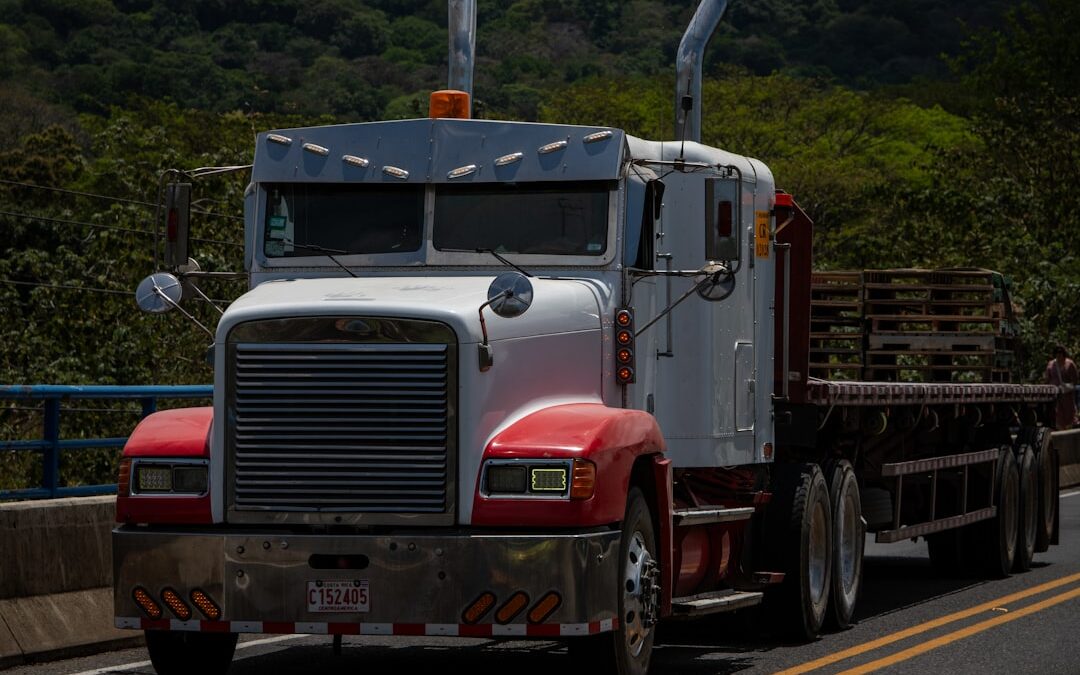
DEF delivery for fleets is one of the most overlooked — and most costly — logistics gaps in diesel fleet management today. If your trucks run on diesel and were built after 2010, they require a steady supply of Diesel Exhaust Fluid (DEF) to stay compliant, stay on the road, and stay out of trouble with EPA emissions standards.
Here’s what you need to know upfront:
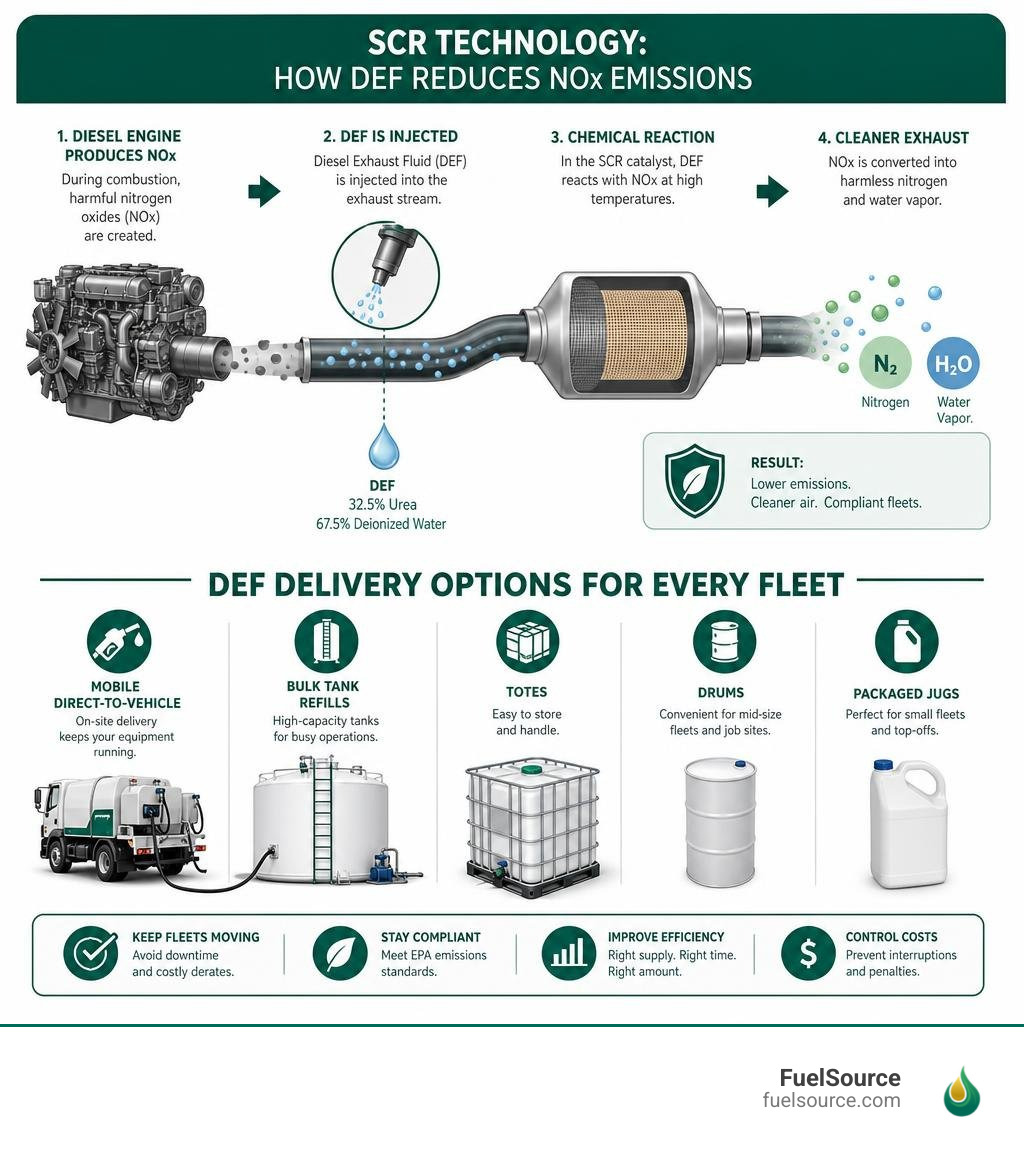
- What it is: DEF is a solution of 32.5% urea and 67.5% deionized water, injected into the exhaust system to break down harmful NOx emissions
- Who needs it: Any fleet running diesel vehicles or equipment built after January 2010
- How much you need: Roughly 2–5% of your diesel consumption — about 1 gallon of DEF for every 25–50 gallons of diesel
- What happens without it: Vehicles derate (lose power), slow down, or won’t start — causing expensive downtime
- How to get it: Mobile direct-to-vehicle delivery, bulk tank refills, totes, drums, or packaged jugs — depending on your fleet size and location
For fleet managers in construction, farming, and logistics, a DEF shortage isn’t just an inconvenience — it can shut down an entire job site.
I’m Kyle Behnke, and through my work at FuelSource, I’ve seen how poor DEF delivery for fleets planning leads to preventable downtime across Atlanta-area and North Georgia operations. In this guide, I’ll walk you through everything you need to manage your DEF supply with confidence.
Def delivery for fleets vocab explained:
Understanding DEF and Its Role in Modern Fleet Fuel Delivery
To optimize your supply chain, it helps to understand the science behind Diesel Exhaust Fluid and why your vehicles cannot run without it.
DEF is not a fuel additive. It is carried in a completely separate, dedicated tank on the vehicle and is never mixed with diesel fuel. Instead, it is sprayed directly into the exhaust stream.
Why DEF is Essential for Fleet Compliance
The core technology behind modern diesel emissions reduction is Selective Catalytic Reduction (SCR). When diesel fuel burns, it produces harmful nitrogen oxides (NOx), which are primary contributors to air pollution and smog.
The SCR system injects small, precisely metered amounts of DEF into the exhaust pipe upstream of a catalytic converter. Once inside, the high heat causes the DEF to vaporize and decompose into ammonia and carbon dioxide. The ammonia then reacts with the NOx inside the catalyst, breaking the harmful gases down into harmless nitrogen and water vapor.
This process reduces tailpipe emissions by over 90%. Because of this massive environmental benefit, the EPA mandated strict emissions standards for all medium and heavy-duty diesel vehicles starting in January 2010.
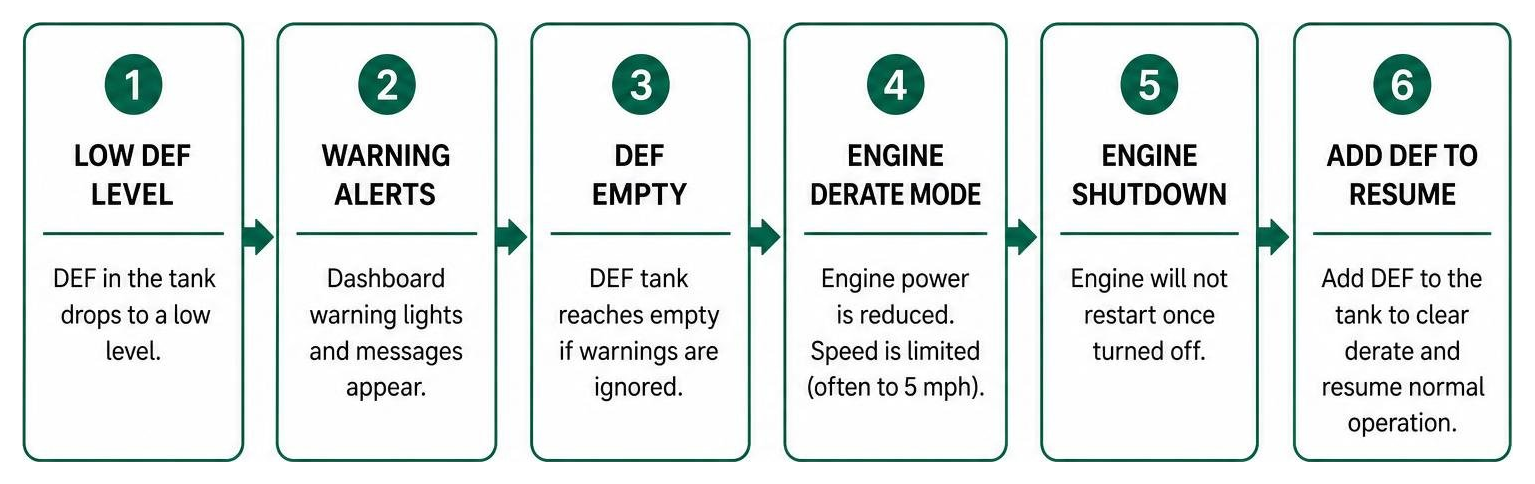
If your vehicles run out of DEF, the engine’s onboard computer will initiate an “engine derate.” This safety feature throttles the vehicle’s speed — often down to a crawl of 5 mph — and may prevent the engine from restarting once turned off. This is designed to force compliance, but for a business operating in Fulton County or Gwinnett County, it means a stranded truck, missed deliveries, and potentially voided manufacturer warranties.
Learn more about DEF for heavy equipment to see how these regulations directly impact off-road machinery and yellow iron.
Calculating Your Fleet’s DEF Consumption Rates
A common question we hear from fleet managers in Marietta GA and Canton GA is: “How much DEF do we actually need to order?”
As a general rule of thumb, DEF consumption is directly tied to your diesel fuel usage. Modern SCR-equipped engines consume DEF at a rate of approximately 2% to 5% by volume relative to diesel consumption.
To put that into perspective, if a heavy-duty truck consumes 100 gallons of diesel on a route through Metro Atlanta, it will require roughly 2 to 5 gallons of DEF. On average, a truck can travel about 800 miles on a single gallon of DEF, though this varies significantly based on vehicle class, load weight, and duty cycle.
| Vehicle Class | Average Diesel MPG | DEF Consumption Rate | Estimated DEF Gallons Needed per 1,000 Miles |
|---|---|---|---|
| Light Duty (e.g., diesel pickups) | 14 – 16.5 MPG | ~2.0% | 1.2 – 1.4 Gallons |
| Medium Duty (e.g., box trucks, delivery vans) | 9 – 11.5 MPG | ~3.0% | 2.6 – 3.3 Gallons |
| Heavy Duty / Off-Road (e.g., Class 8 trucks, excavators) | 5 – 7.5 MPG | ~4.0% – 5.0% | 5.3 – 10.0 Gallons |
By tracking your fleet’s weekly diesel consumption, you can easily forecast your DEF needs and establish a delivery schedule that prevents emergency shortages.
Streamlining Logistics with DEF Delivery for Fleets
Managing DEF internally can quickly turn into a logistical nightmare. If you rely on your drivers to top off their DEF tanks at retail truck stops, you are losing money in more ways than one.
Eliminating Downtime with Mobile DEF Delivery for Fleets
When drivers pull up to a retail pump to purchase DEF, they face retail markup prices that are often 25% to 50% higher than bulk delivery rates. Worse yet, the time spent pulling off the highway, waiting in line, and manually filling the tank adds up to significant driver downtime.
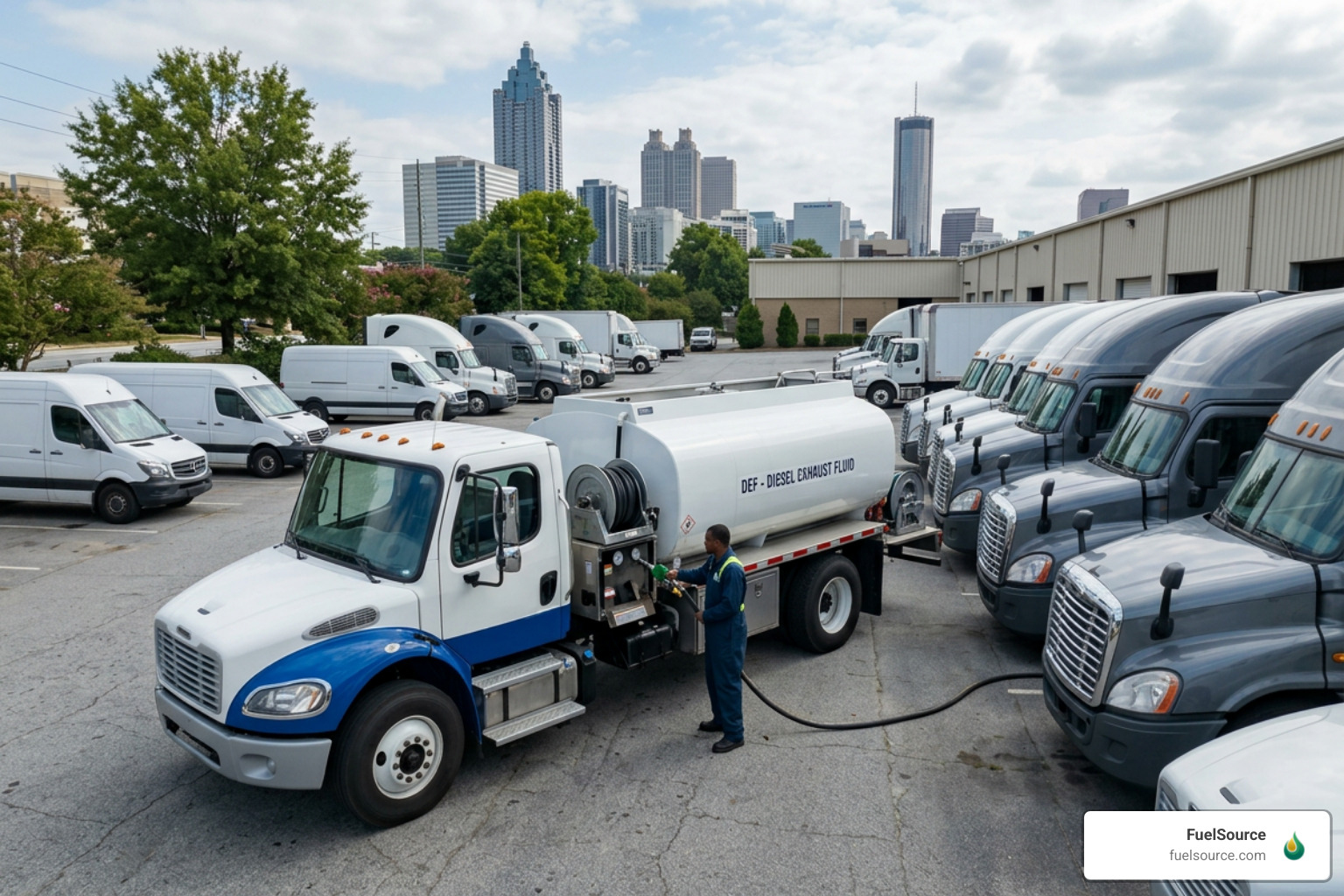
Mobile def delivery for fleets solves this by bringing the fluid directly to your yard or job site. With direct-to-vehicle mobile refueling, certified technicians fill your vehicles’ DEF tanks during off-hours — such as overnight or over the weekend.
This retail pump bypass keeps your drivers on the road and focused on their routes. It also improves driver safety. Manually lifting and pouring heavy 2.5-gallon jugs of DEF is physically taxing and increases the risk of accidental spills. Because DEF is highly corrosive to metals like copper and brass, spills on or around the vehicle engine can cause long-term damage.
Discover the benefits of on-site fleet fueling and DEF delivery to see how on-site fleet fuel delivery and fluid management can transform your daily operations.
Integrating DEF with Fleet Fuel Delivery Services
The most efficient way to manage your fleet’s fluids is to integrate your def delivery for fleets with your regular fleet fuel delivery.
Instead of managing multiple invoices, scheduling separate delivery windows, and dealing with different vendors for diesel and DEF, you can utilize a single-vendor solution. When our delivery trucks arrive at your yard in DeKalb County, Cobb County, or Cherokee County, we can fuel your trucks with diesel and top off their DEF tanks at the exact same time.
This consolidated approach simplifies your administrative workload, provides unified invoicing, and maximizes route optimization. By leveraging advanced logistics technology, such as Google Maps Fleet Engine, delivery routes are planned with pinpoint accuracy. This ensures that your fuel and DEF arrive precisely when needed, minimizing fuel burn and reducing delivery gaps by up to 25%.
Evaluating DEF Options, Storage, and Handling Best Practices
Depending on the size of your fleet and the layout of your facility, different storage and delivery methods may suit your business.

Read our guide on bulk DEF delivery near you to explore the physical footprint and infrastructure requirements for various storage options.
Bulk DEF Delivery and Tote Refill Programs
For larger operations using 300 to 600 gallons of DEF weekly, bulk delivery is the most cost-effective option.
We can deliver DEF in bulk directly into your on-site storage tanks, which typically range from 1,000 to over 4,000 gallons. For fleets that need high volume but lack permanent tank infrastructure, 330-gallon or 200-gallon intermediate bulk container (IBC) totes are an excellent middle ground.
These totes are equipped with heavy-duty electric pumps, long hoses, and automatic shut-off nozzles. Under a tote exchange or refill program, we monitor your usage and refill the totes on-site, ensuring you always have a steady supply without the upfront capital expense of permanent bulk tanks.
Packaged DEF Options: Drums, Jugs, and Pallets
If you run a smaller fleet or need portable options for remote construction sites in Bartow County, Paulding County, or Walton County, packaged DEF is highly practical:
- 55-Gallon Drums: Perfect for medium-sized operations. They offer good volume without taking up too much space and can be fitted with manual or electric drum pumps.
- 2.5-Gallon Jugs: Ideal for emergency backup storage in the truck cab or for fleets with only a few diesel vehicles. We deliver these by the pallet to keep your warehouse stocked.
Preventing Contamination in DEF Delivery for Fleets
DEF is incredibly sensitive to contamination. Because it is made of high-purity synthetic urea and deionized water, even a microscopic speck of dirt, fuel, oil, or metal can ruin the entire batch.
If contaminated DEF is pumped into an SCR system, it can cause the catalyst to fail, trigger immediate engine derating, and result in thousands of dollars in repair costs.
To prevent this, we use strict closed-loop delivery and storage systems. This means the fluid is never exposed to the open air from the moment it leaves our transport truck to the moment it enters your vehicle or storage tank. Furthermore, all dispensing equipment — including pumps, hoses, and nozzles — must be made of compatible materials like stainless steel or high-density polyethylene (HDPE).
Find out why your fleet needs a reliable North Georgia DEF supplier who understands the strict handling standards required to keep your engines running cleanly.
Frequently Asked Questions About Fleet DEF Management
Managing DEF logistics can raise several questions regarding compliance, storage, and technology. Here are the answers to the most common questions we receive from fleet managers.
What happens if a diesel vehicle runs out of DEF?
When the DEF tank runs low, the vehicle’s dashboard will display warning lights. If those warnings are ignored and the tank empties completely, the engine will enter “derate mode.”
The vehicle’s speed will be restricted (often to 5 mph), and the engine will not restart once turned off. This is a federal emissions requirement built into the vehicle’s software. To get the truck moving again, you must add DEF to the tank.
If you find yourself in this situation, you can get emergency bulk DEF service when you need it most to quickly get your vehicles back on the road.
How long can DEF be stored before it degrades?
DEF has a shelf life of approximately two years if stored under optimal conditions.
The fluid should be kept out of direct sunlight and stored at temperatures between 40°F and 80°F. If DEF is exposed to extreme heat (sustained temperatures above 86°F), the water will evaporate and the urea will decompose faster, shortening its shelf life.
Additionally, a 32.5% urea DEF solution will begin to crystallize and freeze at 12°F (-11°C). When freezing occurs, the fluid expands by about 7%. However, freezing does not damage the chemical composition of DEF. Once it thaws, it is completely safe to use. Just ensure your storage containers have enough head space to accommodate expansion during cold North Georgia winters.
How do automatic refill programs prevent DEF shortages?
The easiest way to prevent a DEF stockout is through wireless tank monitoring and automatic replenishment.
By installing cellular or radar-based tank monitors on your bulk tanks or totes, we can track your fluid levels in real time. When your inventory drops below a predetermined threshold (e.g., 30%), our system automatically schedules a delivery.
Using advanced logistics tools like Drop Fleet Last Mile Software, we track usage trends, forecast your consumption, and coordinate deliveries during your fleet’s non-peak hours. This removes the administrative burden of manual inventory checks and guarantees you never run dry.
Conclusion
Managing def delivery for fleets doesn’t have to be a complicated, time-consuming chore. By partnering with a dependable local supplier, you can eliminate driver downtime, protect your engines from contamination, and lower your total operating costs.
At FuelSource, we bring over 30 years of industry experience, state-of-the-art delivery equipment, and a dedicated team serving Metro Atlanta and North Georgia — including Fulton, DeKalb, Gwinnett, Cobb, Cherokee, and Forsyth counties.
Through our advanced customer portal, you get instant access to delivery reports, real-time tank levels, and detailed tracking data to simplify your IFTA tax reporting. Whether you need mobile direct-to-vehicle refueling, bulk tank fills, or pre-filled 330-gallon totes, we have you covered.
Schedule your DEF fluid delivery today and let us keep your fleet moving.