
Why Your Agricultural Equipment Fuel Supply Determines Your Season’s Success
Agricultural equipment fuel supply is the backbone of every productive farm operation. When fuel runs out mid-harvest or mid-plant, everything stops — and those lost hours can’t be recovered.
Here’s a quick overview of your main options for keeping farm equipment fueled on-site:
| Method | Best For | Key Benefit |
|---|---|---|
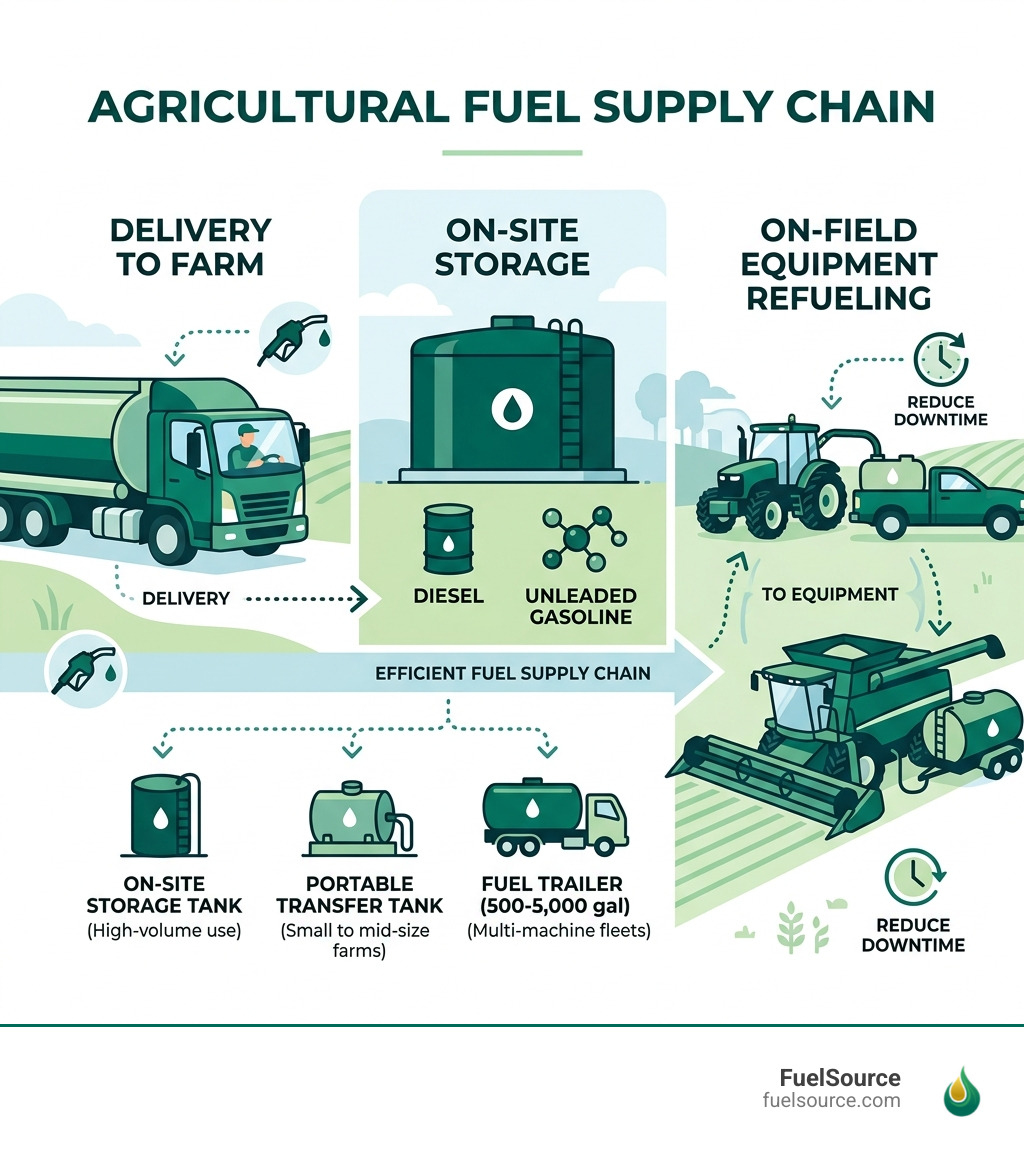
| Mobile fuel delivery | Remote fields, large operations | Fuel comes to your equipment |
| On-site storage tank | High-volume seasonal use | Always have fuel ready |
| Portable transfer tank | Small to mid-size farms | Low-cost, flexible setup |
| Fuel trailer (500–5,000 gal) | Multi-machine harvest fleets | Refuel multiple units per trip |
The core idea is simple: the less time your equipment spends waiting for fuel, the more work gets done. Driving a tractor or combine back to the yard for a fill-up can eat 30 to 45 minutes each way. Multiply that by a full harvest season, and you’re looking at a serious drag on your operation.
Modern farms run primarily on diesel — and U.S. agriculture consumed over 500 billion Btu of diesel energy in 2016 alone. That number has only grown as farms scale up and equipment gets more powerful.
I’m Kyle Behnke, and I work with FuelSource to help farm and fleet operations in the Atlanta metro and North Georgia region build smarter agricultural equipment fuel supply strategies. In the sections below, we’ll walk through everything from fuel types and delivery options to storage, safety, and compliance.
Optimizing Your Agricultural Equipment Fuel Supply for Peak Season
As we look toward the busy cycles of April 2026, the difference between a profitable season and a stressful one often comes down to logistics. In Georgia, our planting and harvest windows can be tight, especially when the weather decides not to cooperate. If you are still hauling equipment to a retail gas station or driving a pickup back and forth with a small transfer tank, you are likely losing more money than you realize.
Reliable fuel delivery is critical because downtime is expensive. When the sun is shining and the moisture levels are just right, every minute your combine or tractor sits idle is a minute of potential yield lost. By moving to a professional agricultural equipment fuel supply model, you shift the burden of logistics to us, allowing you to focus on the dirt.
| Feature | Retail Gas Station Refueling | On-Site Fuel Delivery |
|---|---|---|
| Labor Cost | High (Drive time + Fill time) | Low (Fueling happens in-field) |
| Equipment Wear | High (Road miles on tractors) | Zero (Equipment stays in field) |
| Fuel Quality | Standard #2 Diesel | Premium Diesel + Additives |
| Availability | Station hours/accessibility | 24/7 reliability |
For more on how energy powers the farm, check out The complete guide to agricultural energy solutions.
The Role of Diesel and DEF in Agricultural Equipment Fuel Supply
Diesel is the lifeblood of the modern farm. Whether you are running a legacy tractor or a brand-new combine, diesel provides the torque and energy density required for heavy-duty work. To put the scale in perspective, tilling a single acre can consume anywhere from 0.30 to 2.10 gallons of diesel, while fertilizing can take up to 1.05 gallons per acre. Across a large operation in Cherokee or Bartow County, those gallons add up fast.
However, modern diesel engines (those manufactured after 2010) require more than just fuel; they need Diesel Exhaust Fluid (DEF). DEF is essential for the Selective Catalytic Reduction (SCR) systems that help modern engines run up to 90% cleaner than older models. Running out of DEF is just as bad as running out of diesel—your equipment will likely go into “limp mode” to prevent emissions violations, effectively halting your work. We offer dedicated DEF Fluid Delivery to ensure you never have to worry about your SCR system shutting you down.
Ready to simplify your logistics? You can easily Order Fuel online to get ahead of the seasonal rush.
Propane and Alternative Energy for Irrigation and Drying
While diesel powers the wheels, propane often powers the infrastructure. In North Georgia, propane is a versatile player in the agricultural equipment fuel supply ecosystem. It is commonly used for:
- Irrigation Engines: Propane engines are often less expensive to purchase than diesel equivalents and can provide 15,000 to 20,000 hours of service life with proper maintenance.
- Grain Dryers: Propane is the standard for efficient crop drying, providing the consistent heat necessary to prep grain for storage.
- Weed Control: Flaming with propane is an effective alternative to chemical herbicides for some organic operations.
Beyond propane, biodiesel blends (up to B20) are becoming more common. These are often made from domestic soybeans, supporting the very industry they power. Using alternative fuels can sometimes qualify your operation for grants, such as the REAP program, which helps transition farms to cleaner energy.
The Benefits of Mobile and On-Site Fuel Delivery for Farms
The most significant benefit of mobile fuel delivery is the gift of time. Farmers who have switched to in-field refueling report saving over 100 labor hours per harvest season. Think about that: that’s two and a half weeks of full-time work reclaimed just by eliminating trips to the fuel pump.
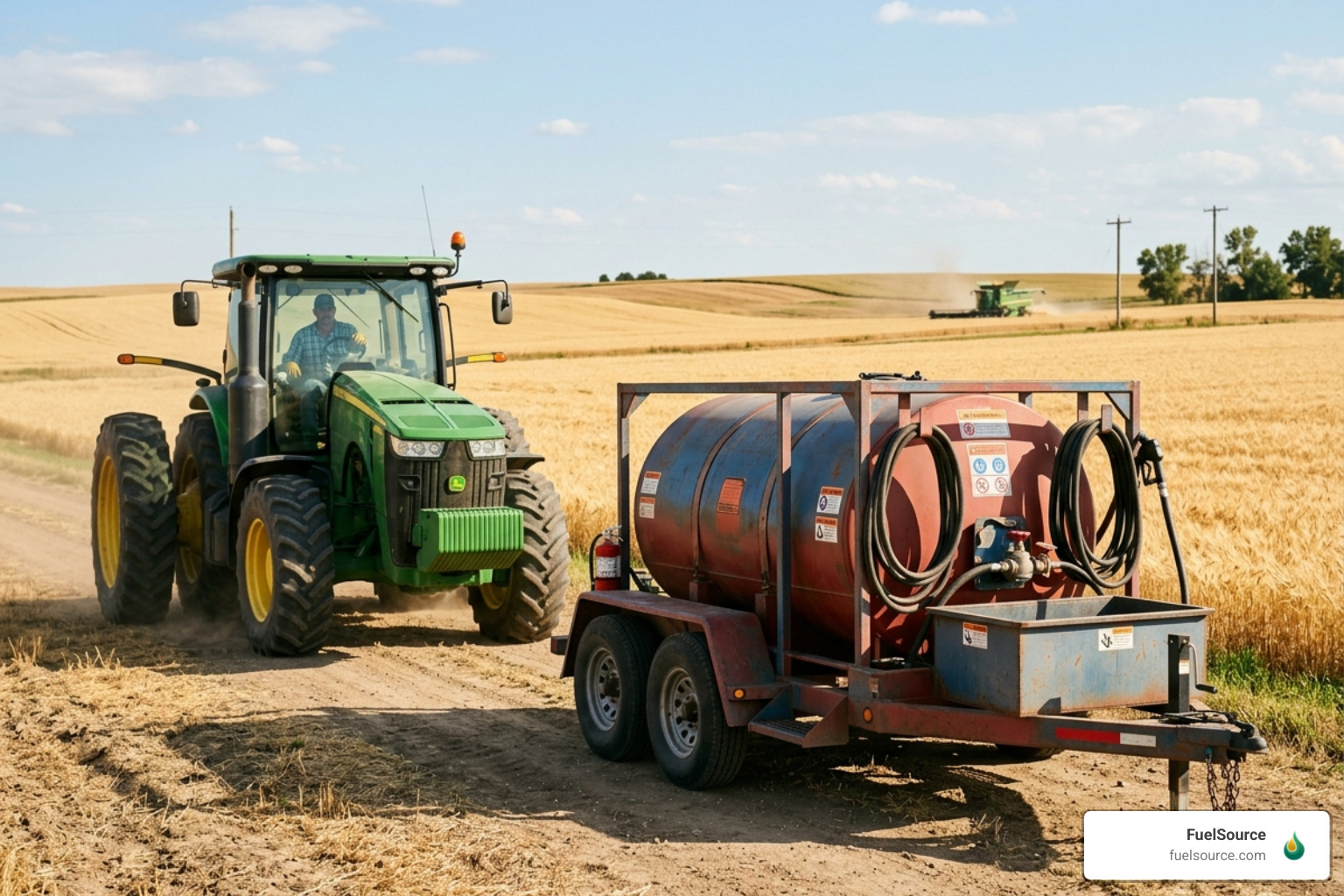
When we bring the fuel to your remote fields in Paulding or Forsyth County, we aren’t just dropping off a product; we’re providing an uptime insurance policy. This is especially true for On-Site Fueling, where we can fill your equipment during “off-hours” so it’s ready to go the moment your crew arrives at sunrise.
To understand why this service is so vital to our local economy, read Why Atlanta Fuel Delivery Services Are the Lifeblood of Georgia Business.
Custom Contracts and Fuel Price Risk Management
The agricultural market is famously unpredictable. Between weather patterns and fluctuating commodity prices, the last thing you need is a surprise jump in fuel costs. Many of our partners utilize custom fuel contracts to lock in pricing. This budget predictability allows you to calculate your cost-per-acre with much higher accuracy.
Whether you need bulk transport for a large storage system or scheduled fleet fuel delivery for your service trucks and tractors, a custom contract ensures you aren’t at the mercy of daily market spikes during the peak of harvest.
Regulatory Compliance for Your Agricultural Equipment Fuel Supply
Navigating the legal side of fuel transport can be a headache, but it’s essential for staying on the right side of the Department of Transportation (DOT).
One of the most important regulations for farmers is 49 CFR 395.1(k). This provides Hours of Service (HOS) exemptions for the transportation of “farm supplies” (which includes fuel). To qualify for this exemption, you generally must meet these criteria:
- The fuel must be used for agricultural purposes (tractors and farm equipment, not personal SUVs).
- The transport must happen within the state-defined planting and harvesting seasons.
- The delivery must stay within a 100 air-mile radius of the distribution point.
- The entire load must be intended for farm use.
Understanding these rules keeps your drivers safe and your operation compliant while moving fuel across county lines in North Georgia.
Best Practices for Safe Mobile Refueling and Storage
Safety is non-negotiable when dealing with thousands of gallons of combustible liquid. Proper agricultural equipment fuel supply management requires a “safety first” mindset, starting with how you position your tanks.

When refueling in remote fields, always:
- Position Downwind: Park your fuel source downwind from the equipment being filled.
- Level Ground: Ensure all tanks and trailers are on stable, level ground to prevent spills or tipping.
- Spill Kits: Always carry a spill response kit, including absorbent pads and gloves. EPA fines for violations can be staggering, sometimes exceeding $25,000 per day.
- Engine Off: It sounds basic, but always shut off engines and allow them to cool slightly before refueling.
For a deeper dive into managing your diesel safely, see Tank Goodness: The Heavy Lifter’s Guide to Reliable Diesel Delivery.
Portable Tanks and Fuel Trailer Specifications
If you prefer to handle the “last mile” of fueling yourself, you need the right hardware.
- Non-DOT Containers: These are limited to 119 gallons per container. If you need to haul more than that on a trailer, you must use a DOT-approved tank.
- Fuel Trailers: These typically range from 500 to 5,000 gallons. For mid-size farms (500–1,500 acres), a 500 to 1,000-gallon trailer is usually the “sweet spot” for efficiency.
- Transfer Pumps: Match your pump’s Gallons Per Minute (GPM) to your needs. A 12V pump usually delivers 15–20 GPM, which is fine for small tractors, but larger combines may require high-flow gas-powered pumps delivering 25–35 GPM to minimize downtime.
For more technical advice on field setups, check out Mobile Refueling on the Farm: Best Practices for Remote Fields.
Monitoring and Maintenance of On-Farm Storage
If you have on-site tanks, maintenance is key to protecting your investment. We often recommend wireless tank monitoring. This technology allows us (and you) to see exactly how much fuel is left in real-time via a smartphone app. No more climbing ladders with a “stick” to measure levels or, worse, running dry on a Sunday afternoon.
We offer tank rentals ranging from 650 to 20,000 gallons, providing flexibility for seasonal spikes. However, large tanks require vigilance against:
- Moisture: Temperature swings in Georgia can cause condensation inside the tank.
- Microbial Growth: Water in the tank leads to “diesel bugs”—bacteria and fungi that create a thick sludge.
- Filtration: Always use a 10-micron filter on your discharge hose to catch contaminants before they reach your engine.
Maximizing Equipment Longevity with Premium Fuels and Lubricants
The engines in today’s tractors and combines are marvels of engineering, but they are also incredibly sensitive. High-pressure common rail (HPCR) fuel systems operate at pressures up to 30,000 PSI. Even a microscopic speck of dirt or a tiny drop of water can ruin an injector, leading to a repair bill that could easily reach five figures.
Using premium diesel is an investment in your equipment’s longevity. Premium fuels contain terminally injected additives that:
- Prevent injector deposits.
- Improve fuel stability during storage.
- Reduce sooty exhaust and filter plugging.
- Provide better lubricity for fuel pumps.
If you’re looking to upgrade to cleaner, more efficient equipment, there is often EPA funding for clean ag equipment available through programs like DERA or REAP.
Preventing Contamination in Modern Diesel Engines
Contamination is the #1 enemy of agricultural equipment fuel supply. To keep your fleet running:
- Use Fresh Fuel: Diesel can start to degrade after six months. Mobile delivery ensures you are always using fresh, stable fuel.
- Water Separation: Ensure your equipment’s water separators are drained daily.
- Tank Cleaning: If you use on-site storage, have your tanks professionally cleaned every few years to remove accumulated “bottom sludge.”
The Importance of Specialized Agricultural Lubricants
Fuel gets you moving, but lubricants keep you moving. Agricultural machinery operates in extreme environments—think of the dust of a dry Georgia July or the freezing mud of a late November harvest.
Specialized lubricants, including tractor hydraulic fluids and heavy-duty gear oils, are designed to maintain their viscosity under these high-friction, high-heat conditions. Using the right grease on your combine’s header or the right oil in your tractor’s transmission can extend the life of your machinery by years.
Frequently Asked Questions about Farm Fueling
How much diesel does a tractor use per acre?
Fuel consumption varies by the type of work being done. For light tasks like fertilizing, you might use around 1.05 gallons per acre. For heavy-duty tilling or primary tillage, consumption can jump to between 1.50 and 2.10 gallons per acre. Modern, efficient engines can lower these numbers, while older, uncontrolled engines will use significantly more.
What are the requirements for the agricultural HOS exemption?
Under 49 CFR 395.1(k), you are exempt from Hours of Service regulations if you are transporting farm supplies (like fuel) to a farm within a 100 air-mile radius during the planting and harvesting season. The fuel must be used strictly for agricultural production and the driver must be operating in interstate or intrastate commerce as defined by the state of Georgia.
Can I store gasoline and diesel in the same mobile trailer?
Technically, yes, if the trailer is designed with separate, isolated compartments. However, you must be extremely careful with labeling and hose management. Gasoline requires much stricter fire protection standards, including flame arrestors and specific setback distances, because it is far more volatile than diesel. Most farmers find it safer and easier to use dedicated trailers or tanks for each fuel type.
Conclusion
Managing your agricultural equipment fuel supply shouldn’t be a source of stress. Whether you are farming a few hundred acres in Cobb County or managing a massive operation across North Georgia, the goal is the same: maximum uptime and minimum hassle.
At FuelSource, we bring over 30 years of experience to the field. We understand the unique needs of Georgia farmers because we live and work here too. From Marietta to Canton and everywhere in between, we provide the high-quality diesel, DEF, and gasoline you need to keep your equipment running at peak performance. Plus, our customer portal makes managing your fuel spend and IFTA reporting easier than ever.
Don’t let fuel logistics slow you down this season. Schedule your on-site agricultural fuel delivery today and experience the difference that professional, reliable service makes for your farm.