Understanding 93 Octane and Ethanol Blends
To locate 93 ethanol-free gas near you, use dedicated online mapping directories like Pure-Gas.org, check specialty stations near marinas, general aviation airfields, and drag strips, and always verify that the pump uses a dedicated E0 nozzle. For commercial equipment and fleets, direct bulk delivery provides an efficient alternative to searching retail stations.
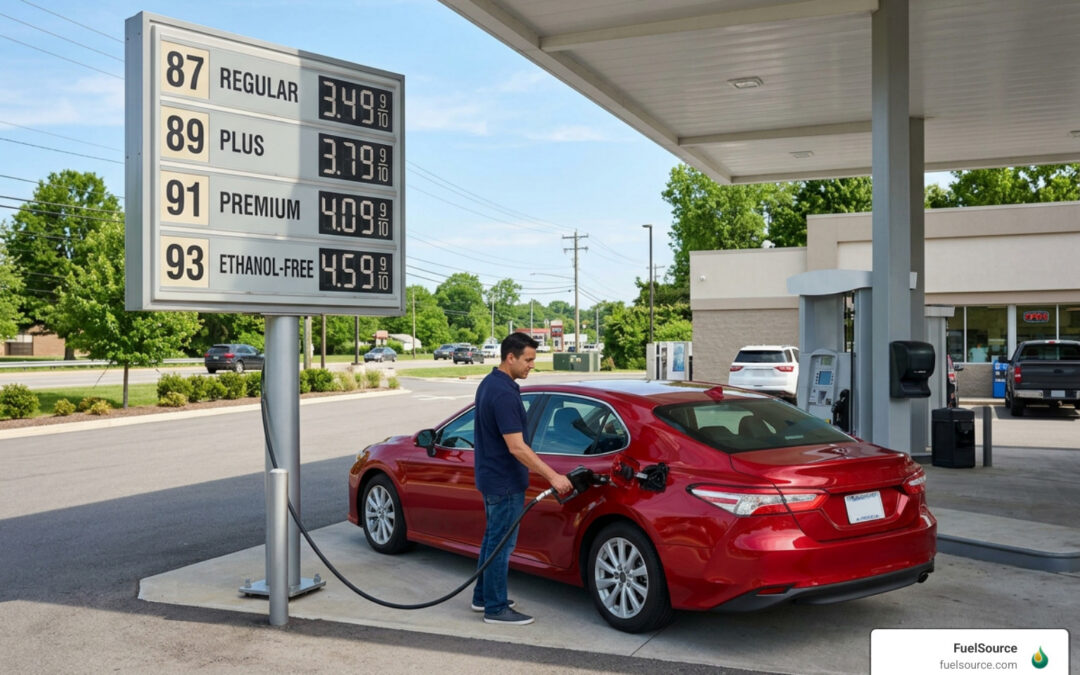
When drivers see the bold “93” on a pump dispenser, many naturally assume it represents pure, unadulterated high-octane gasoline. In modern retail distribution, that is almost never the case. Most premium gasoline sold today is an E10 blend, formulated with up to 10% denatured ethanol by volume.
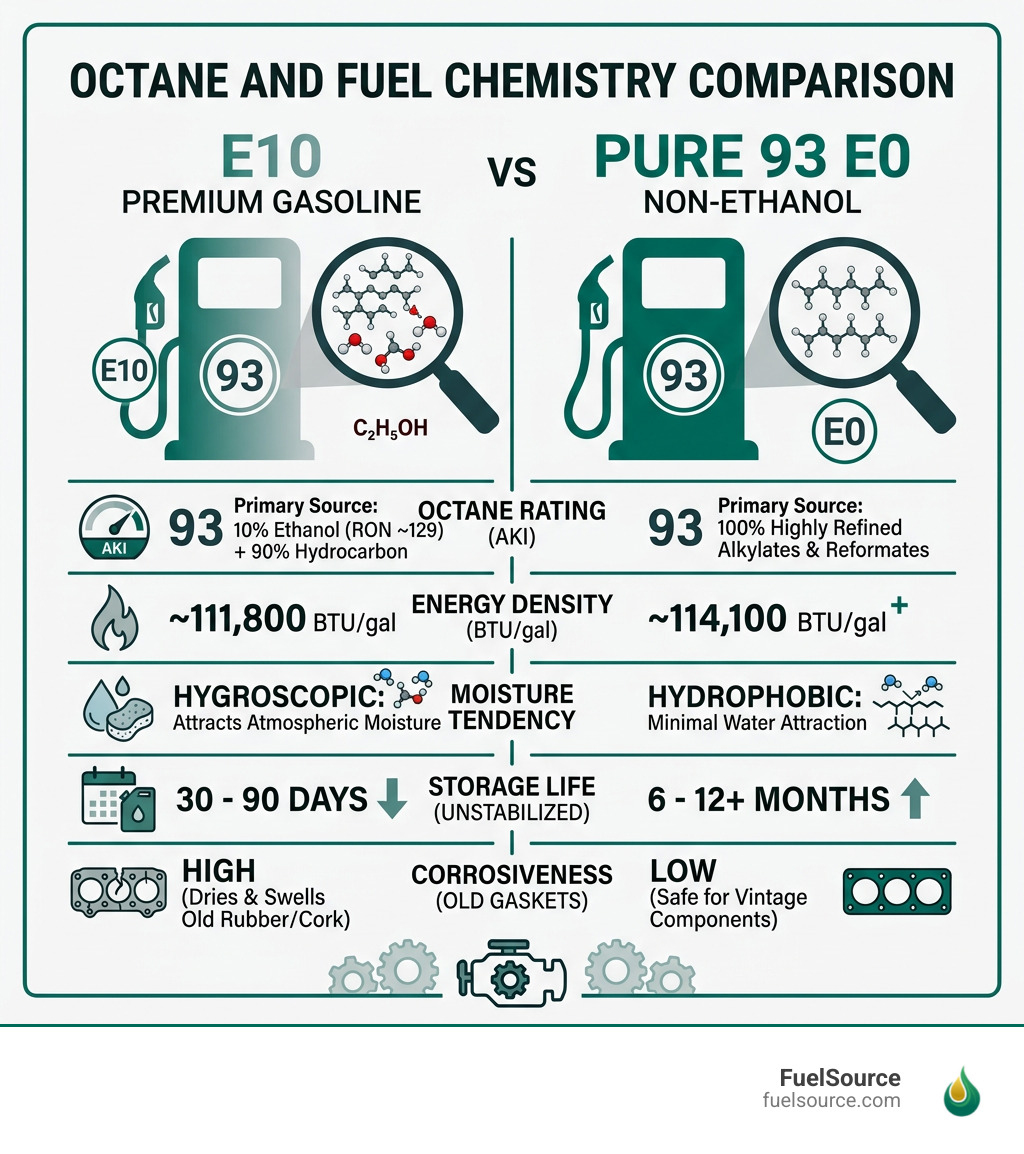
Refiners rely heavily on ethanol because of its chemical properties. Ethanol boasts a Research Octane Number (RON) of approximately 129, compared to conventional base gasoline blending stocks that typically range from 85 to 95 RON. By splashing a low-cost, high-octane component into lower-grade hydrocarbon bases, fuel suppliers can achieve that coveted 93 anti-knock index easily and affordably.
While ethanol works well as an octane booster for everyday commuting in modern vehicles, it alters the chemical stability of the fuel. Pure 93 E0 gasoline—fuel with zero alcohol additives—relies on high-quality alkylates and aromatic hydrocarbons to achieve its 93 octane rating naturally. As discussed in technical breakdowns like Is 93 Octane Ethanol Free? – Engineer Fix, understanding what goes into your tank is essential for high-performance tuning, long-term storage, and mechanical longevity.
| Feature / Characteristic | Standard E10 Premium Gasoline | Pure 93 Octane E0 Non-Ethanol |
|---|---|---|
| Ethanol Content | Up to 10% by volume | 0.0% (Pure hydrocarbon) |
| Octane Rating (AKI) | 93 Octane | 93 Octane |
| Primary Octane Source | Ethanol blending (RON ~129) | Refined alkylates / reformates |
| Hygroscopic Tendency | High (Attracts atmospheric moisture) | Minimal / Hydrophobic |
| Storage Life (Unstabilized) | 30 to 90 days | 6 to 12+ months |
| Energy Density (BTU/gal) | ~111,800 BTU/gal | ~114,100 BTU/gal |
| Corrosiveness to Old Gaskets | High (Dries out rubber/cork) | Low / Safe for vintage components |
Why Drivers Search for 93 Ethanol Free Gas Near Me
The demand for non-ethanol premium fuel is driven by chemistry. Ethanol is hygroscopic, meaning it constantly pulls moisture directly out of the ambient air. In modern, pressurized fuel tanks that burn through a full tank every week, this moisture is rarely a major concern. However, for carbureted engines, seasonal equipment, or classic cars, that trapped water triggers serious mechanical headaches.
When water contamination in an E10 fuel blend reaches roughly 0.5% by volume, a destructive chemical reaction known as phase separation occurs. The ethanol leaves its bond with the gasoline, binds with the water molecules, and falls to the bottom of the fuel tank as a murky, highly acidic layer.
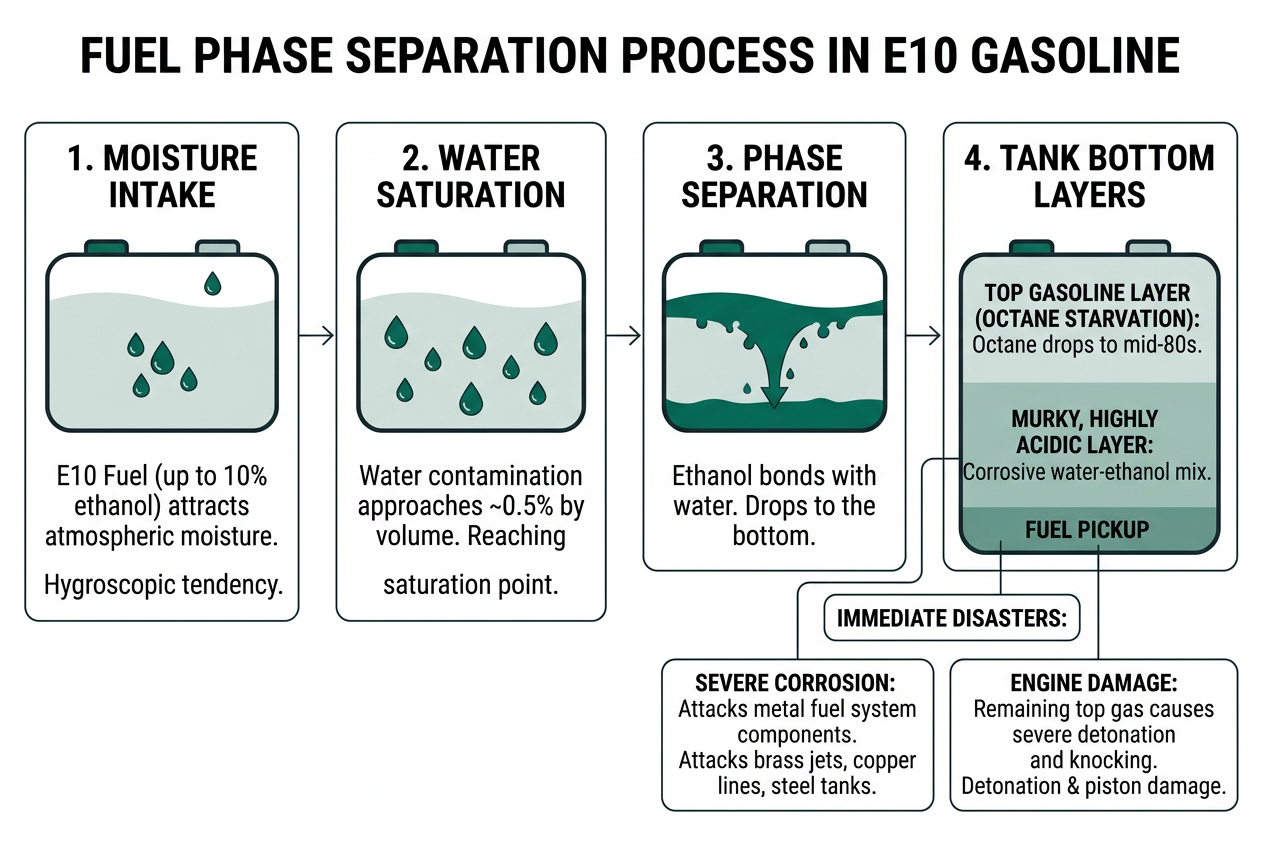
This separated layer creates two immediate disasters:
- Severe Corrosion: The bottom water-ethanol mix sits directly over your fuel pickup, attacking brass carburetor jets, copper fuel lines, aluminum floats, and steel tanks.
- Octane Starvation: The remaining gasoline floating on top has lost its octane booster, dropping from 93 octane down into the mid-80s. When an unsuspecting driver accelerates, the engine experiences severe detonation, knocking, and potential piston damage.
Owners of high-performance vintage muscle cars, track vehicles, high-output commercial landscape tools, marine outboards, and emergency backup generators prioritize pure 93 E0 to avoid this corrosive breakdown entirely.
Key Differences Between REC-90 and 93 E0
While hunting for ethanol-free gasoline across North Georgia, you are far more likely to encounter REC-90 (Recreational 90) than pure 93 E0.
REC-90 is an ethanol-free blend refined specifically to an anti-knock index of 90. It was originally engineered for marine vessels, powersports, and two-stroke outdoor power equipment. For standard lawnmowers, pressure washers, and naturally aspirated boat engines, REC-90 provides adequate protection against fuel degradation.
However, high-compression engines, supercharged motors, modern turbocharged platforms, and tuned racing vehicles require greater detonation resistance than 90 octane can provide. Running a 90-octane fuel in a motor mapped for 93 can cause the electronic control unit (ECU) to retard timing, drastically cutting power output and throttle response. In vintage high-compression engines without modern knock sensors, running 90 octane under heavy load risks catastrophic pre-ignition. That is why enthusiasts and performance operators track down genuine 93 E0.
How to Locate 93 Ethanol Free Gas Near Me
Finding genuine 93 non-ethanol fuel requires a proactive strategy. True 93 E0 pumps are relatively rare, and assuming a station has it simply because they sell premium can result in wasted trips and contaminated fuel systems. Rather than burning time wandering between retail pumps, many commercial operators choose to stop driving to the pump and let the fuel come to you.
If you are on the road searching for a retail pump, follow these direct steps:
- Identify Candidate Hubs: Look near recreational waterways, performance drag strips, general aviation airfields, and rural farming hubs across Cherokee, Paulding, Forsyth, and Cobb counties.
- Call Ahead: Never rely solely on an automated search listing. Call the counter clerk and ask: “Is your dedicated ethanol-free pump currently dispensing 93 octane, or is it 87 or 90 octane?”
- Inspect the Physical Pump: When you arrive, examine the decals on the pump face and inspect the dispensing hose setup.
Using Digital Tools to Find 93 Ethanol Free Gas Near Me
Crowdsourced web directories and specialized mapping applications are your best starting point. Platforms such as the community directory at Pure-gas.org – ethanol-free gasoline in the U.S. and Canada catalog verified non-ethanol fuel locations across North America, allowing users to filter by state, county, and verified fuel grades.
When utilizing mobile mapping tools and station listings:
- Check the Timestamp: Look for listings verified within the last few months (such as updates throughout 2026). Stations occasionally convert dedicated E0 tanks to standard E10 premium or diesel if regional wholesale availability changes.
- Review User Notes: Community comments frequently highlight whether a pump features a standalone nozzle or shares a line with blended fuels.
- Save Reliable Waypoints: Once you find a verified retail location in areas like Marietta, Canton, or Decatur, log it for future route planning.
On-Site Verification and Pump Inspection Checklist
Before inserting your card and squeezing the nozzle, run through this field checklist at the pump:
Watch out for single-hose dispensers! If a dispenser uses a single hose to pump 87 E10, 89 E10, and 93 E0, the internal line holds roughly one-third of a gallon from the previous customer’s purchase. If the person before you bought cheap 87 E10, that first third of a gallon going into your small vintage motorcycle tank or fuel can is blended ethanol. Always favor stations that provide a completely separate, dedicated hose for their ethanol-free fuel.
Practical Storage and Delivery Alternatives for Bulk E0 Fuel
Driving multiple miles with a truck bed full of five-gallon plastic jugs to source pure high-octane gasoline gets old quickly. It also introduces safety risks and fuel contamination hazards. For commercial landscaping outfits, private automotive collections, racing shops, and farm operations across the Atlanta Metro area, establishing on-site fuel solutions is much more efficient.
When keeping high-octane fuel on-site:
- Use Heavy-Duty, Sealed Storage: Store fuel in clean, dedicated metal containers or certified double-walled bulk tanks out of direct sunlight.
- Seal Tightly: Pure gasoline does not pull atmospheric water like ethanol, but its lightest, most volatile hydrocarbons will evaporate over time if left unsealed, gradually reducing its octane rating.
- Eliminate Retail Trips: Setting up scheduled gasoline delivery ensures your fleet equipment, tractors, and backup systems are charged with pure, uncompromised fuel directly on-site.
For growing operations managing large machinery inventories, discovering how to save big with georgia bulk gasoline delivery helps lower administrative burdens and cuts down on unbillable driver hours. When emergencies hit or peak project deadlines demand immediate refueling, securing the fastest fuel delivery near you right now keeps crews moving without missing a beat.
Frequently Asked Questions About Non-Ethanol Premium Gasoline
Is 93 octane premium gasoline always ethanol-free?
No. In fact, the vast majority of 93 octane fuel sold at standard highway gas stations contains up to 10% ethanol (E10). Federal renewable fuel standards and state clean-air programs encourage ethanol blending across standard commercial supply lines. Premium fuel will only be ethanol-free if the pump dispenser is explicitly marked with an official “E0,” “Non-Ethanol,” or “0% Ethanol” label.
What happens if water mixes with ethanol-blended fuel?
When water enters an E10 blend through condensation or humid air intake, the ethanol bonds with the water and separates from the petroleum hydrocarbons. This phase-separated sludge settles at the base of the tank, corroding fuel pumps, plugging filters, destroying rubber lines, and leaving a low-octane gasoline layer on top that causes engine knocking and misfires.
Can any gasoline vehicle run on 93 octane non-ethanol fuel?
Yes. Any vehicle or power equipment engineered to run on pump gasoline can safely burn 93 octane non-ethanol fuel. While modern daily commuters with adaptive ECUs may only require standard 87 octane, running 93 E0 will not damage the engine, catalytic converters, or oxygen sensors. It simply provides maximum shelf stability, zero ethanol-related corrosion, and reliable knock protection.
Conclusion
Finding verified 93 octane ethanol-free fuel protects valuable equipment, improves shelf life for seasonal vehicles, and delivers the anti-knock performance demanded by high-output engines. Whether you run vintage classics, high-compression race platforms, commercial landscaping machinery, or essential emergency generators, ditching ethanol helps avoid expensive carburetor repairs and phase-separation headaches.
At FuelSource, we know that time spent hunting down specialty retail pumps is time lost on the job. We bring over 30 years of fuel delivery expertise to commercial and industrial operations throughout Atlanta, Marietta, Canton, Decatur, and across North Georgia. With advanced mobile fueling equipment, real-time reporting portals, and scheduled fleet fuel delivery, our team ensures your tanks, job sites, and fleet operations always have the pure, high-grade fuel they need to keep moving forward.