
Why Gasoline Bulk Delivery in Georgia Can Save Your Business More Than You Think
Gasoline bulk delivery in Georgia is a straightforward concept with a big impact: instead of sending drivers to retail pumps, a fuel supplier brings wholesale gasoline directly to your storage tanks, job site, or fleet.
Here’s a quick summary of what you need to know:
- What it is: Scheduled or on-demand delivery of gasoline in large volumes direct to your location
- Who it’s for: Fleet managers, construction companies, farms, logistics operators, and any business with high fuel consumption
- Key benefit: Wholesale pricing eliminates retail markup, reducing one of your largest operating costs
- How it works: A tanker delivers fuel to your on-site storage tank; you dispense it on your own schedule
- Minimum orders: Typically start as low as 100 gallons, with common deliveries ranging from 2,500 to 8,500 gallons
- Who to call: A licensed Georgia fuel distributor with emergency delivery capability and transparent pricing
Fuel is one of the biggest line items for any fleet or equipment-heavy operation. And yet, many businesses in Georgia still send drivers to retail stations — paying retail markups, losing productive hours, and risking costly downtime when a pump is broken or a truck runs dry on a job site.
The math adds up fast. Freight carriers can consume upwards of 10,000 gallons a year per truck. School bus fleets burn through nearly 2,000 gallons per bus annually. At retail prices, those numbers hit hard.
Bulk delivery changes that equation entirely.
My name is Kyle Behnke, and I work with FuelSource Inc. in the Atlanta area, where I’ve spent my career helping Georgia businesses cut fuel costs and eliminate supply headaches through smarter gasoline bulk delivery in Georgia solutions. In the sections below, I’ll walk you through everything you need to make an informed decision — from pricing and storage to choosing the right supplier for your specific operation.
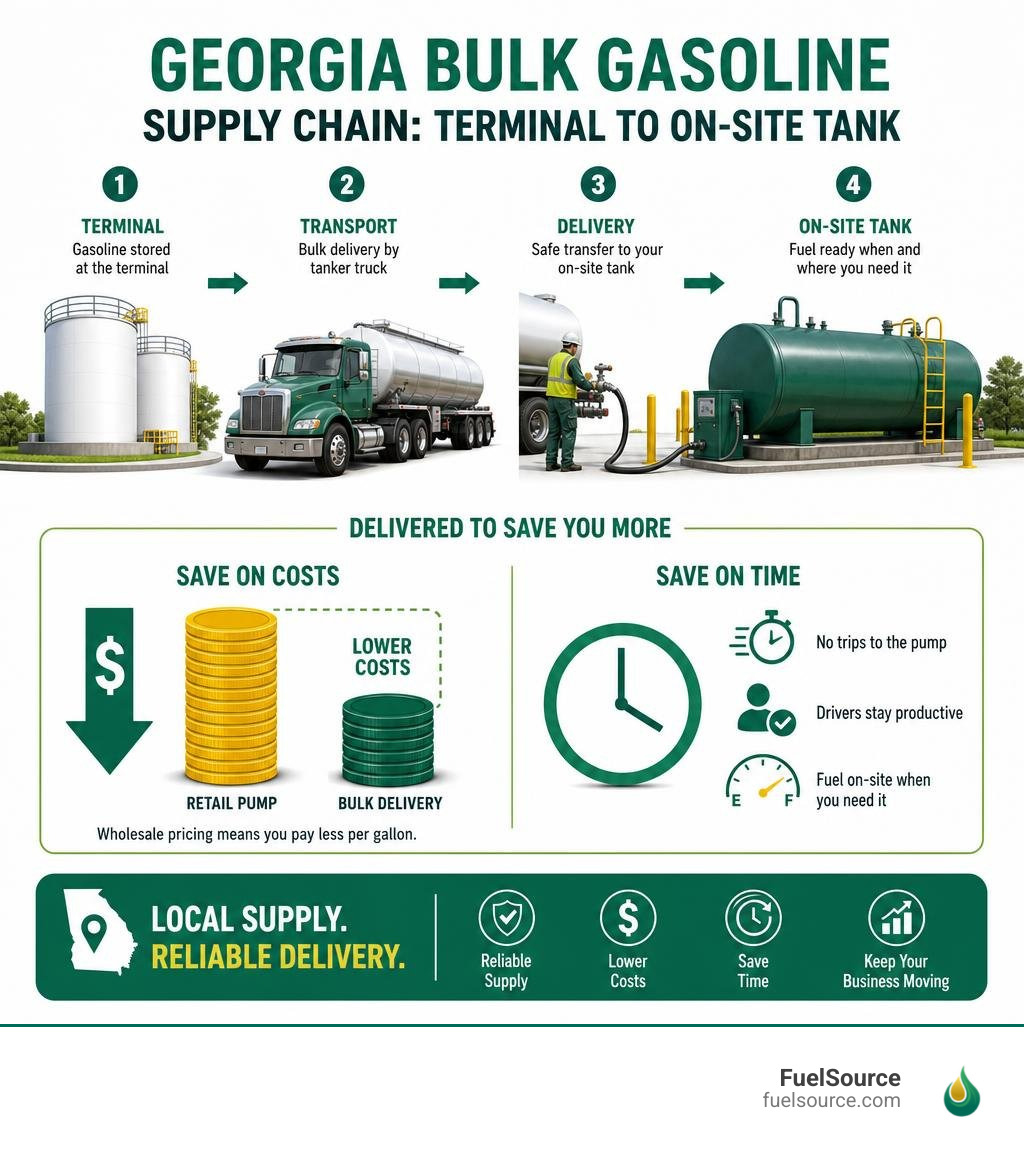
Gasoline bulk delivery Georgia terms simplified:
Understanding Bulk Gasoline Delivery vs. Retail Fueling

When we talk about bulk gasoline delivery, we are looking at a complete shift in how your business handles energy. In Georgia, retail fueling means sending your light-duty trucks, vans, or equipment to standard gas stations in Decatur GA or Marietta GA, paying a premium that includes convenience store markups, local taxes, and retail overhead.
Conversely, bulk delivery brings wholesale fuel directly from regional terminals to your private storage tanks. By buying in high volumes, you bypass the middleman. This on-site fueling capability gives you complete control over your fuel inventory and eliminates the daily administrative headaches of managing dozens of individual retail receipts.
| Feature | Retail Fueling | Bulk Gasoline Delivery |
|---|---|---|
| Pricing Structure | Retail pump price (highest markup) | Wholesale rack-plus pricing (volume discounts) |
| Time Investment | Drivers travel, wait, and pump during work hours | Fuel is delivered to your site; zero driver downtime |
| Administrative Effort | Auditing multiple credit cards and paper receipts | Centralized, itemized billing with automated reporting |
| Fuel Quality Control | Dependent on gas station tank maintenance | Monitored, filtered, and treated on-site storage |
| Emergency Availability | Vulnerable to local station runouts and power outages | Dedicated reserve tanks and priority disaster supply |
Why Businesses are Moving Away from the Pump
Every minute your employee spends driving to a retail station, waiting in Atlanta Metro traffic, and standing at the pump is a minute of lost productivity. If you operate a fleet of delivery vans in Fulton County or landscaping trucks in Gwinnett County, these small trips quietly drain your bottom line.
Labor costs are often the hidden culprit. If a driver earning $25 an hour spends 20 minutes refilling a vehicle three times a week, that is hours of paid time wasted every single month per vehicle. This is why more companies are choosing to Stop Driving to the Pump and Let the Fuel Come to You. Switching to an on-site system transforms refueling from an active chore into a passive, background utility.
Key Industries Benefiting from Bulk Fuel Delivery in Georgia
Our commercial landscape relies heavily on consistent energy distribution. From heavy infrastructure projects in Bartow County and Cherokee County to logistics hubs in Cobb County, bulk gasoline and diesel delivery keep the gears turning. Any business using light-duty fleets, generators, or small engines can leverage these services to establish a competitive edge.
Fleet Fueling and Transportation
For transportation and delivery fleets operating across North Georgia, fuel logistics dictate profitability. Freight carriers pump upwards of 10,000 gallons a year into big rig tanks to deliver 72 percent of America’s goods and materials, and school districts see each school bus consume nearly 2,000 gallons of fuel annually.
Managing these massive volumes at retail pumps is a recipe for operational chaos. By utilizing mobile fueling or bulk tank installations, fleet operators can streamline their entire logistical footprint. This explains Why Atlanta Fleet Fuel Delivery is the Lifeblood of Georgia Business, as on-site fuel availability ensures that vehicles are fully fueled and ready to roll before the driver even clocks in for the day.
Construction and Heavy Equipment
Construction sites in rapidly growing areas like Canton GA and Forsyth County cannot afford equipment downtime. When excavators, skid steers, and generators run out of fuel, projects grind to a halt, triggering costly delay penalties.
Having a dedicated bulk gasoline and diesel tank on-site allows your team to refuel equipment during natural work pauses. This keeps your workforce focused on the project rather than hunting down fuel. Whether you require unleaded gasoline for light machinery or off-road diesel for heavy earthmovers, securing reliable Gasoline Delivery directly to your job site is the most efficient way to keep your operations moving forward.
Managing Costs and Pricing in the Georgia Fuel Market

The wholesale fuel market is dynamic, influenced heavily by crude oil trends, refinery outputs, seasonal demand shifts, and regional pipeline logistics. For businesses in Georgia, navigating this volatility requires more than simply watching the local pump prices. By partnering with a bulk supplier, you gain access to wholesale pricing structures that are directly tied to regional rack prices, shielding you from the retail price spikes common during summer travel seasons or supply disruptions.
The Economics of Gasoline Bulk Delivery Georgia
To manage fuel budget volatility effectively, many commercial operations rely on flexible pricing programs. Reliable fuel partners offer price risk management solutions.
These programs include:
- Fixed Forward Pricing: Lock in a set price per gallon for a specified volume and time frame, ensuring budget predictability regardless of market swings.
- Index Pricing: Purchase fuel at prices directly tied to trusted market indexes (like OPIS), ensuring you always pay fair, transparent wholesale rates.
- On-Board Truck Technology: Utilizing modern delivery fleets with metered tickets ensures you pay only for the exact volume of fuel dispensed into your tanks, eliminating guesswork.
Ensuring Quality, Safety, and Regulatory Compliance
Handling bulk gasoline requires strict adherence to safety and environmental standards. Because gasoline is highly volatile and flammable, bulk deliveries in Georgia must comply with all Environmental Protection Agency (EPA) and Occupational Safety and Health Administration (OSHA) guidelines. This includes maintaining proper spill prevention protocols, utilizing certified transport equipment, and ensuring that delivery drivers are fully HAZMAT-trained and certified. For federal spill-prevention guidance, the EPA’s Spill Prevention, Control, and Countermeasure (SPCC) rule explains requirements designed to help prevent oil and fuel releases into navigable waters and adjoining shorelines.
To ensure your fuel remains clean and free of water or contaminants, we recommend several best practices:
- Regular Tank Testing: Check your storage tanks periodically for water accumulation, which can lead to microbial growth and fuel degradation.
- High-Quality Filtration: Ensure your dispensing pumps are equipped with high-grade particulate and water-removing filters.
- Additives: Utilize premium additives to prevent gasoline from degrading during periods of lower usage. Standard unleaded gasoline can begin to degrade if left sitting for extended periods without treatment.
Storage Tanks and On-Site Fueling Equipment
Your choice of on-site storage equipment is critical for both safety and convenience. Commercial tanks generally range from 500-gallon skid tanks for smaller operations to permanent 21,000-gallon double-walled tanks for high-volume industrial yards. For flexible transportation, tank wagon services can deliver loads ranging from 20 to 6,000 gallons directly to your site.
Modern fuel management relies heavily on technology. Smart tank systems utilize wireless monitoring to track fuel levels in real time. This data is accessible via secure online portals, allowing you to monitor inventory levels without manually sticking the tank. This prevents runouts and automates the reordering process, so you always have fuel when you need it.
Choosing the Right Partner for Gasoline Bulk Delivery Georgia
Selecting the right fuel partner can make or break your operational efficiency. You need a company that understands the local landscape of North Georgia and Metro Atlanta, from the busy corridors of Cobb County to the expanding industrial parks of Gwinnett County. A reliable partner should offer more than just competitive pricing; they must provide consistent delivery windows, verified fuel quality, and a dedicated support team. For businesses looking for a trusted local partner, Why Your Business Needs a Reliable Atlanta Fuel Company highlights the essential qualities to look for in a distributor.
Scheduling and Logistics for Gasoline Bulk Delivery Georgia
A major factor to consider when choosing a bulk supplier is how they handle scheduling and logistics. Some operations prefer a fixed, recurring schedule (such as weekly or bi-weekly deliveries), while others require the flexibility of on-demand ordering.
When evaluating potential suppliers, ask the following questions:
- What are the minimum order requirements? While large tankers carry thousands of gallons, many tank wagon services can accommodate smaller drops.
- Do they offer next-day delivery? Having the option for next-day dispatch keeps your project on schedule if usage suddenly spikes.
- What emergency fueling capabilities do they have? During major weather events or regional power outages, having a partner with dedicated disaster response resources is invaluable. For more tips on setting up these logistics, refer to The Ultimate Guide to Gasoline Delivery Services Near You.
Frequently Asked Questions About Georgia Bulk Fuel
What is the minimum order for bulk gasoline delivery in Georgia?
While large transport deliveries typically require 7,500 to 8,500 gallons, many local tank wagon services offer much lower minimums. For smaller commercial tanks, minimum delivery quantities often start around 100 gallons, making bulk fueling accessible to mid-sized fleets and job sites.
How do suppliers ensure fuel quality during delivery?
Reputable distributors source their fuel directly from major regional terminals, ensuring it meets strict industry standards. During transport and delivery, the fuel is passed through dedicated filtration systems on the delivery trucks to remove any sediment or moisture before it enters your storage tank.
Are emergency or after-hours fuel deliveries available?
Yes. Many commercial fuel partners in Georgia provide 24/7 emergency response services. This is especially critical for fueling backup generators at hospitals, data centers, and logistical facilities during severe storms or utility outages.
Conclusion
Transitioning to bulk gasoline delivery is one of the most effective ways for Georgia businesses to lower operational expenses, recover wasted labor hours, and secure their energy supply. By bringing the fuel directly to your site, you eliminate the inefficiencies of retail fueling and gain greater control over your fuel budget.
At FuelSource, we bring over 30 years of industry experience to businesses across Atlanta Metro and North Georgia, including Cherokee, Cobb, Fulton, and Gwinnett counties. Our state-of-the-art delivery equipment, combined with an easy-to-use customer portal for instant delivery reports and IFTA tracking, makes managing your fuel supply simple and stress-free.
Ready to see how much your business can save? Contact FuelSource today to get a customized bulk gasoline delivery quote tailored to your fleet or job site.