Why Delivering Gasoline Directly to Your Site Is Changing How Businesses Fuel Up
Delivering gasoline directly to vehicles, equipment, and on-site tanks is one of the fastest-growing services in the commercial fuel industry — and for good reason.
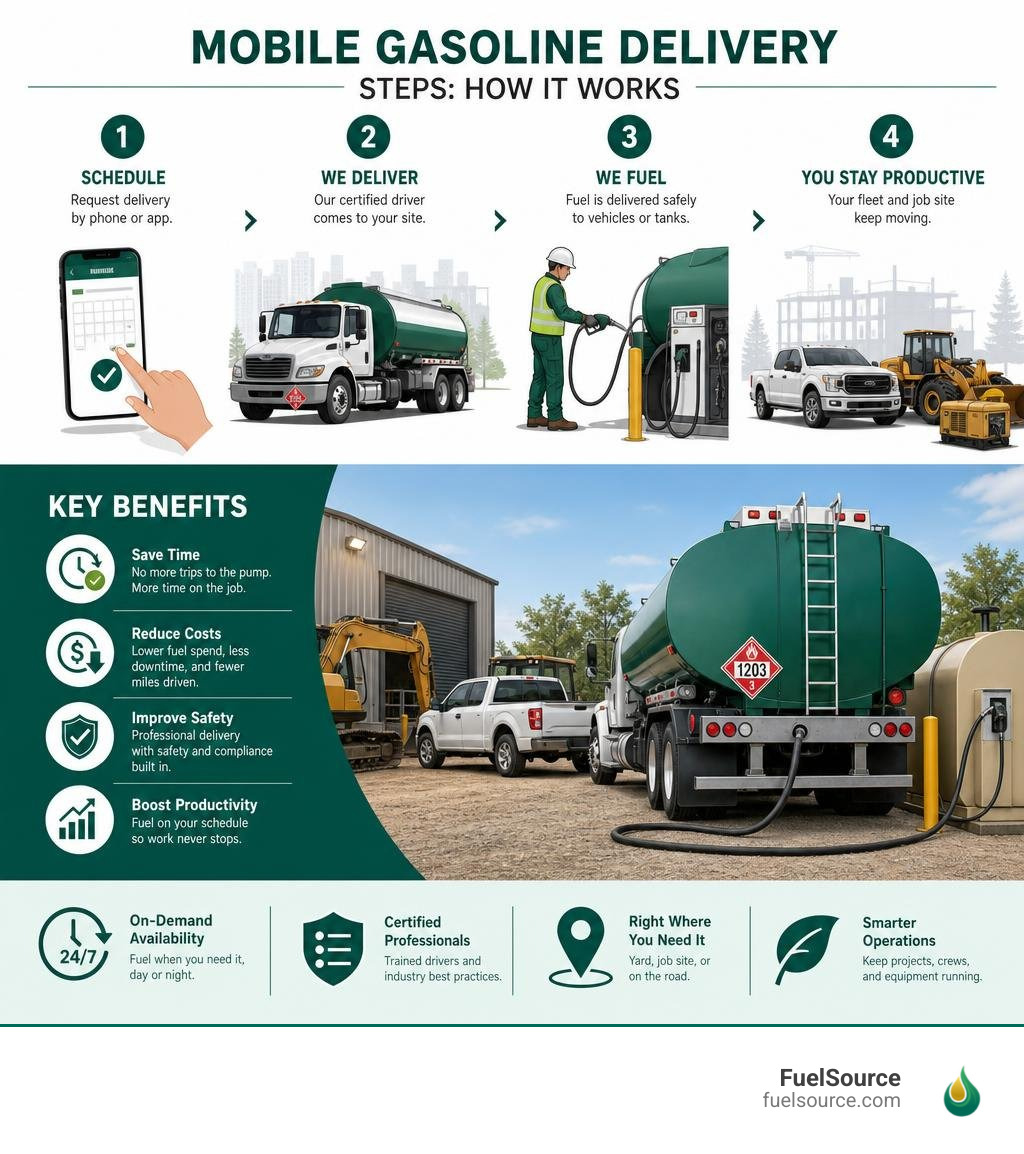
Here’s a quick look at the most common ways it works:
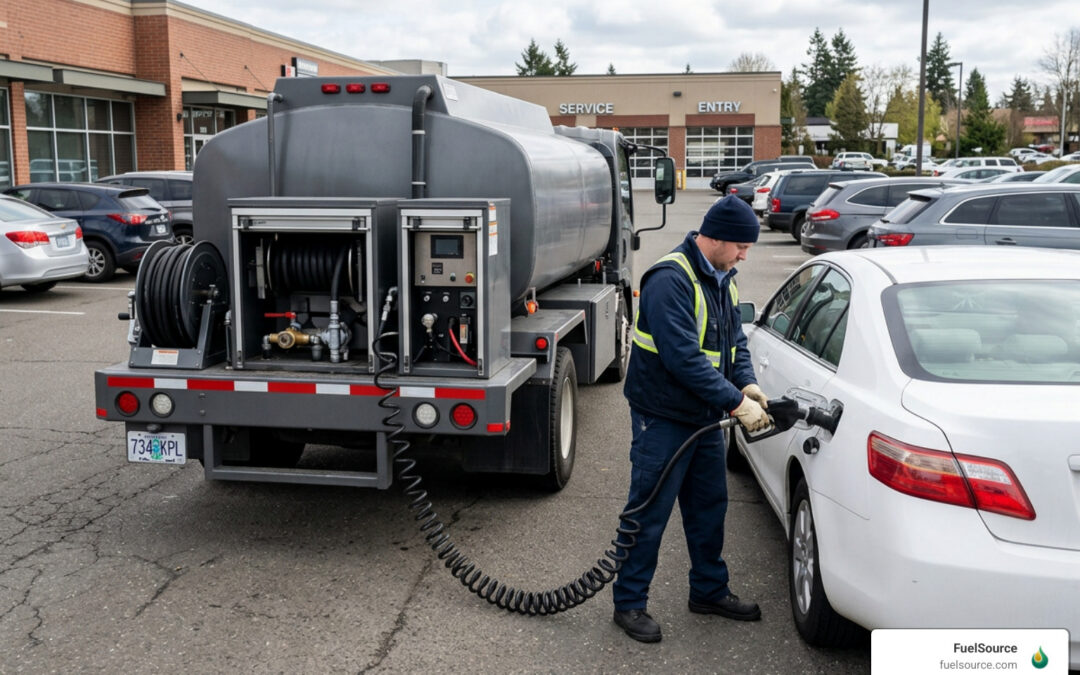
- Direct-to-vehicle fleet fueling — A certified tanker comes to your yard or job site and fuels your vehicles overnight or between shifts.
- Bulk on-site tank refueling — A delivery truck fills your storage tank so your crew can refuel on-demand without leaving the site.
- On-demand mobile fueling — Schedule a one-time or recurring delivery via phone or app for commercial properties and construction sites.
- Emergency and after-hours dispatch — 24/7 fuel delivery when you run out unexpectedly or need to power generators during outages.
If you manage a construction crew, a farm, or a logistics operation, you already know the pain. Equipment sits idle. Drivers burn time making runs to the pump. A broken or empty tank can shut down an entire job site for hours.
The numbers back it up: a single vehicle can waste 61 hours per year on refueling trips alone. For a fleet of 10, the hidden costs can reach $20,000 annually — in lost productivity, added mileage, and fuel card fraud.
Mobile gasoline delivery solves this by bringing the fuel to you, not the other way around.
I’m Kyle Behnke, a business professional with FuelSource Inc. based in the Atlanta area, where I work directly with fleet managers and site operators who rely on fast, compliant gasoline delivery to keep their operations running without interruption. In the sections below, I’ll walk you through exactly how the process works, what it costs, and how to choose the right delivery method for your operation.
Must-know delivering gasoline terms:
The Modern Logistics of Delivering Gasoline

Behind every drop of gasoline that enters a vehicle’s tank lies a highly coordinated downstream logistics network. Understanding how fuel moves from regional distribution hubs to your local job site helps clarify why mobile delivery is so much more efficient than sending individual drivers to a retail gas station.
In our region, the supply chain begins at massive pipeline terminals. From these terminals, fuel logistics engineers coordinate the dispatch of specialized transport trucks. These trucks are massive investments—often costing upwards of $750,000—and are operated by highly trained, middle-aged drivers who work long shifts to keep local commerce moving.
To explore how these distribution networks operate on a macro scale, you can read about the Logistics of the Fuel Industry. An example of a distribution channel | by Dave Volek | Medium.
For businesses in North Georgia, we tap directly into this distribution chain, bypassing retail gas stations entirely. This direct connection ensures that the fuel arriving at your site is fresh, highly refined, and priced closer to wholesale terminal rates.
How Mobile Gasoline Delivery Works
The transition from traditional gas stations to on-site delivery is incredibly simple. Modern mobile fueling utilizes advanced routing software and precise delivery tracking to make the process completely seamless.
Here is the step-by-step process of how we handle delivering gasoline directly to your location:
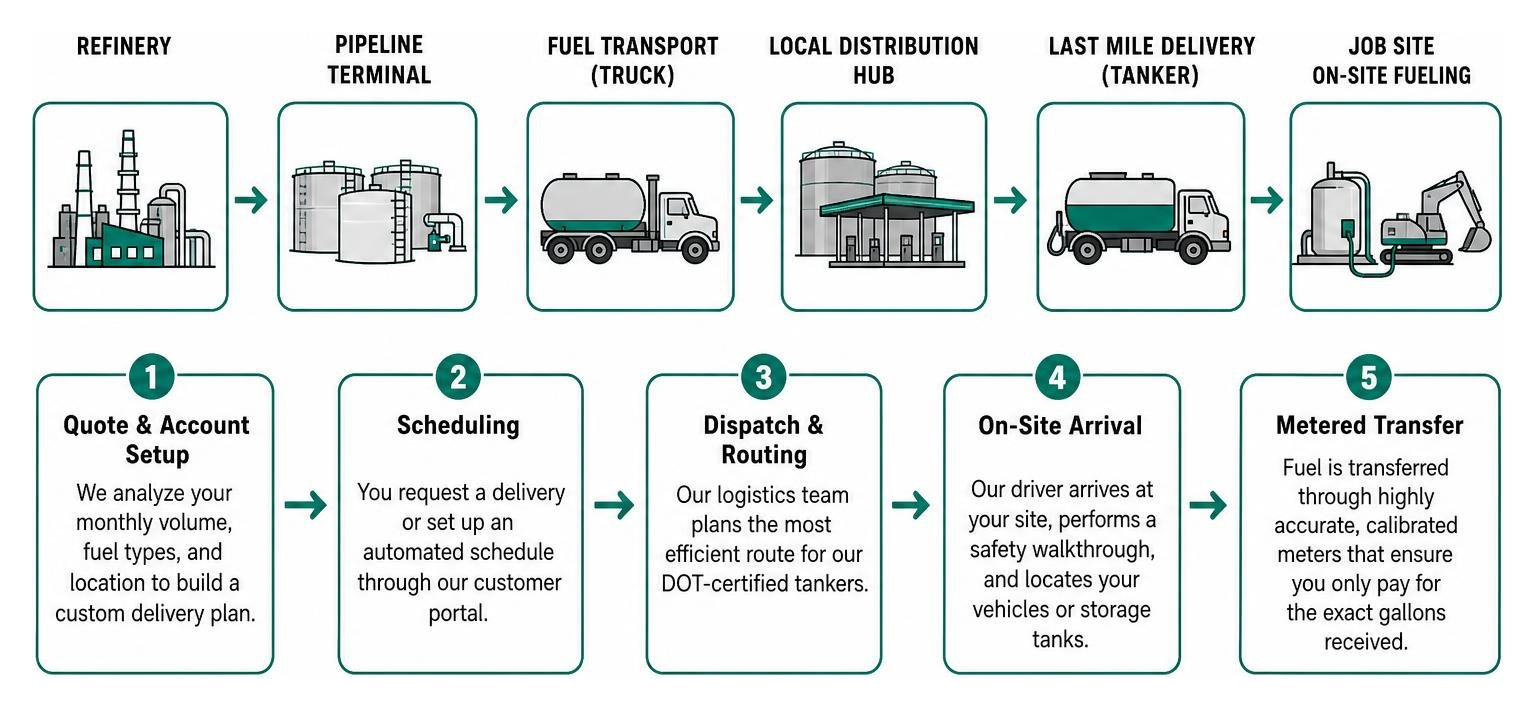
- Quote & Account Setup: We analyze your monthly volume, fuel types, and location to build a custom delivery plan.
- Scheduling: You request a delivery or set up an automated schedule through our customer portal.
- Dispatch & Routing: Our logistics team plans the most efficient route for our DOT-certified tankers.
- On-Site Arrival: Our driver arrives at your site, performs a safety walkthrough, and locates your vehicles or storage tanks.
- Metered Transfer: Fuel is transferred through highly accurate, calibrated meters that ensure you only pay for the exact gallons received.
- Invoicing & Reporting: You receive a digital delivery ticket and detailed reports showing exactly which vehicles were fueled and how much they took.
To dive deeper into setting up this service for your business, check out The Ultimate Guide to Gasoline Delivery Services Near You.
The Environmental and Efficiency Benefits of Delivering Gasoline
By bringing the fuel source directly to your fleet, you eliminate the “off-routing” mileage that occurs when drivers detour to find a retail gas station. This small change has a massive impact on your carbon footprint.
Every year, the average diesel vehicle emits about 587 lbs of CO2 solely during trips to and from the gas station. Multiplying that across a fleet of 15 or 20 vehicles reveals a stunning amount of unnecessary pollution. Because transportation accounts for 28% of all U.S. emissions—with commercial vehicles representing more than a fifth of that total—reducing unnecessary transit miles is one of the easiest ways to meet modern environmental compliance standards.
Financially, the efficiency gains are even more dramatic. Let’s look at how traditional retail fueling stacks up against mobile on-site delivery:
| Feature | Traditional Retail Fueling | Mobile On-Site Delivery |
|---|---|---|
| Labor Cost | Paid hourly rate for drivers to sit in traffic and pump gas | Zero driver labor; fueling occurs during off-hours |
| Wear & Tear | Extra wear on tires, brakes, and engines during detour miles | Zero unnecessary wear and tear on fleet vehicles |
| Fuel Pricing | Retail markup plus local price fluctuations | Wholesale-based pricing with transparent margins |
| Fraud Risk | High risk of fuel card sharing, personal purchases, or theft | Zero fraud; fuel is pumped directly into verified tanks |
| Reporting | Manual receipt tracking and tedious administrative work | Automated, digital reporting with instant IFTA data |
By choosing to stop driving to the pump, you allow your employees to focus entirely on productive, revenue-generating tasks. You can read more about making this transition in our guide on how to Stop Driving to the Pump and Let the Fuel Come to You.
4 Practical Methods for Delivering Gasoline to Your Site
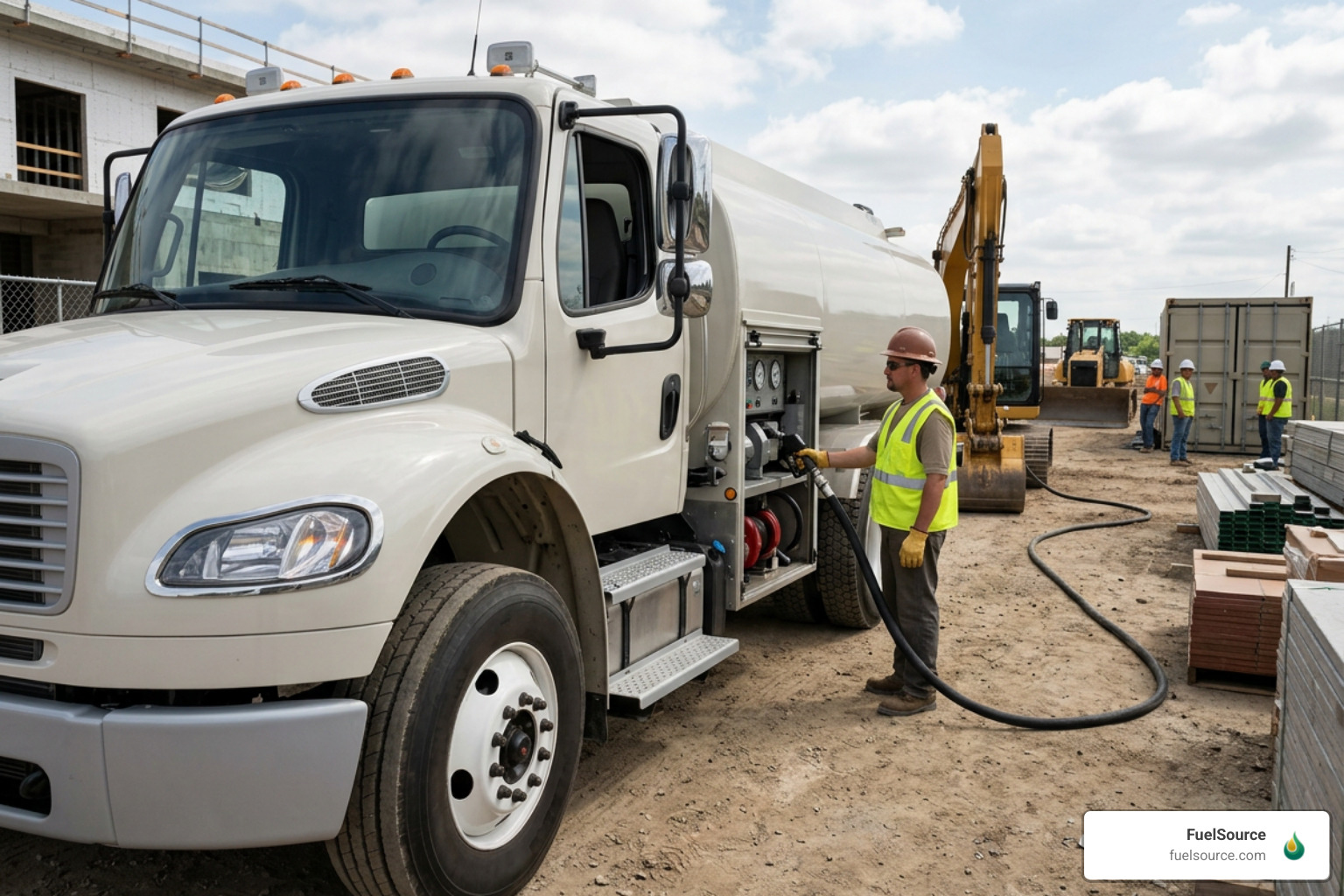
Depending on your industry, vehicle types, and operational schedule, different delivery methods will serve you best. In Metro Atlanta and North Georgia, we provide several flexible options for commercial operations. Whether you need direct fleet fueling or bulk delivery to rural areas, there is a practical solution for your business.
To understand the full scope of these delivery methods, you can view our main Gasoline Delivery page.
1. Direct-to-Vehicle Fleet Fuel Delivery
For businesses operating multiple trucks, vans, or specialized equipment, direct-to-vehicle fleet fuel delivery is a game-changer. Instead of requiring your drivers to start their mornings by waiting in line at a busy retail pump, our certified fuel technicians service your vehicles while they are parked in your yard overnight or between shifts.
This method of fleet fueling offers several distinct advantages:
- Maximized Driver Productivity: Your team starts their shift with a full tank, allowing them to head straight to their first job site.
- Elimination of Fuel Cards: Because our drivers pump fuel directly into your vehicles, you can eliminate physical fuel cards and the administrative headache of tracking down paper receipts.
- Unmatched Cost Control: Our customer portal provides exact data on how many gallons each vehicle consumed, making it simple to calculate job-costing and optimize routes.
2. Bulk On-Site Tank Refueling
If your business operates from a fixed location with heavy equipment—such as a farm, a large landscaping yard, or an industrial facility—keeping a bulk storage tank on-site is often the most cost-effective solution.
With bulk on-site tank refueling, we deliver large quantities of gasoline directly into your private storage tanks. This allows your crew to refuel skid steers, commercial lawnmowers, and utility vehicles on-demand without ever leaving your property.
By utilizing bulk gasoline, you can buy at wholesale terminal prices, cutting out the retail middleman entirely. To protect your investment, we offer double-walled storage tanks with advanced remote monitoring systems that alert us when your fuel level drops below a set threshold, triggering an automatic delivery.
To learn how to maximize these savings in North Georgia, read our detailed article on How to Save Big with Georgia Bulk Gasoline Delivery.
3. On-Demand Mobile Fueling for Commercial Properties
Some businesses do not require daily or weekly fuel deliveries but still need temporary, on-demand fueling for specific projects. This is highly common on construction sites, commercial developments, and temporary event venues.
Our on-demand mobile fueling service allows you to schedule a delivery truck to visit your site and refuel generators, light towers, and heavy earthmoving equipment. This prevents your crew from having to haul heavy, dangerous fuel cans back and forth in the bed of a pickup truck.
Whether you need a quick top-off for a landscaping crew in Marietta or a temporary tank filled in Canton, on-demand delivery keeps your job site moving. If you want to stop wasting valuable work hours on manual fuel runs, check out our guide on Why Waiting for Fuel is So Last Year.
4. Emergency and After-Hours Fuel Dispatch
When a severe storm hits Georgia, power outages can bring operations to a grinding halt. Standby generators at hospitals, data centers, and cold-storage warehouses require a continuous supply of fuel to protect lives and inventory.
Our emergency and after-hours fuel dispatch service operates 24/7/365. If your site is running low or unexpectedly runs out of fuel during a crisis, our logistics team can bypass standard schedules to get a fuel truck to your location immediately.
With over 30 years of experience navigating regional disruptions, we have the state-of-the-art equipment and local expertise required to keep your critical systems online when you need them most.
Safety, Regulations, and Compliance Standards
Because gasoline is a highly volatile, flammable liquid, delivering gasoline requires strict adherence to local, state, and federal safety standards. We treat environmental protection and regulatory compliance as our absolute highest priorities on every single delivery.
To learn more about our safety protocols and industry compliance standards, browse our Category: Gasoline Delivery archives.
Environmental Permits and Vapor Recovery Systems
When transferring gasoline, volatile organic compounds (VOCs) and hazardous air pollutants (HAPs)—such as benzene, toluene, and ethylbenzene—can escape into the atmosphere if not properly managed. To prevent this, environmental agencies require strict vapor recovery measures.
During a fuel transfer, we utilize Stage I vapor recovery systems. These systems capture the gasoline vapors from the receiving tank and safely return them to the delivery vessel rather than letting them escape into the air. All of our delivery trucks undergo annual vapor-tightness testing to ensure that zero emissions are leaked during transit or transfer.
Certifications for Delivering Gasoline Safely
Every driver who operates a FuelSource delivery vehicle is a highly trained professional. To legally transport and dispense gasoline, our drivers must maintain:
- Commercial Driver’s License (CDL Class A or B): Demanding rigorous physical and operational testing.
- HAZMAT (H) Endorsement: Requiring a comprehensive TSA security threat assessment and background check.
- Tanker (N) Endorsement: Ensuring the driver is certified to safely manage the liquid surge of a moving tanker truck.
- NFPA 30A Compliance: Adhering to strict National Fire Protection Association standards for motor fuel dispensing facilities and mobile fueling.
Our trucks are also equipped with advanced grounding and bonding cables to prevent static electricity build-up, along with comprehensive EPA-compliant spill containment kits to handle any unexpected situations instantly.
Frequently Asked Questions About Gasoline Delivery
What are the minimum order sizes for mobile fuel delivery?
For commercial accounts in our service area, our minimum delivery size typically starts at 100 gallons. This threshold allows us to optimize our routes and keep delivery fees as low as possible for our customers. For large-scale fleet fueling or bulk tank refills, we can easily accommodate deliveries up to 10,000 gallons.
How does mobile fueling compare to traditional gas stations in cost?
While retail gas stations mark up their prices to cover the massive overhead of prime real estate, convenience store staff, and credit card fees, mobile fuel delivery is priced relative to wholesale terminal “rack” prices. For businesses consuming high volumes of fuel, purchasing directly from a mobile provider can save substantial money per gallon while completely eliminating the costly labor hours spent driving to the pump.
What types of fuel can be delivered to my job site?
We provide a comprehensive range of fuel options to meet all of your fleet and equipment needs. This includes:
- Gasoline: Available in 87 Unleaded Regular, 89 Midgrade, and 93 Premium.
- Diesel: Ultra-Low Sulfur Diesel (ULSD) for on-road fleets, as well as dyed off-road diesel for construction equipment and agricultural use.
- DEF (Diesel Exhaust Fluid): Delivered packaged or pumped directly into your vehicles alongside your fuel deliveries.
Conclusion
Delivering gasoline directly to your job site, commercial property, or fleet yard is the smartest way to eliminate wasted labor hours, reduce carbon emissions, and protect your business from fuel fraud.
At FuelSource, we bring over 30 years of industry experience, state-of-the-art equipment, and an advanced customer portal for instant reporting directly to businesses across Metro Atlanta and North Georgia—including Cobb, Gwinnett, Fulton, Dekalb, and Cherokee counties.
Let us handle the logistics so you can focus on running your business. To get started, request a custom quote today on our Gasoline Delivery page!